Ständchen («Leise flehen») (Franz Schubert) — practice with piano accompaniment
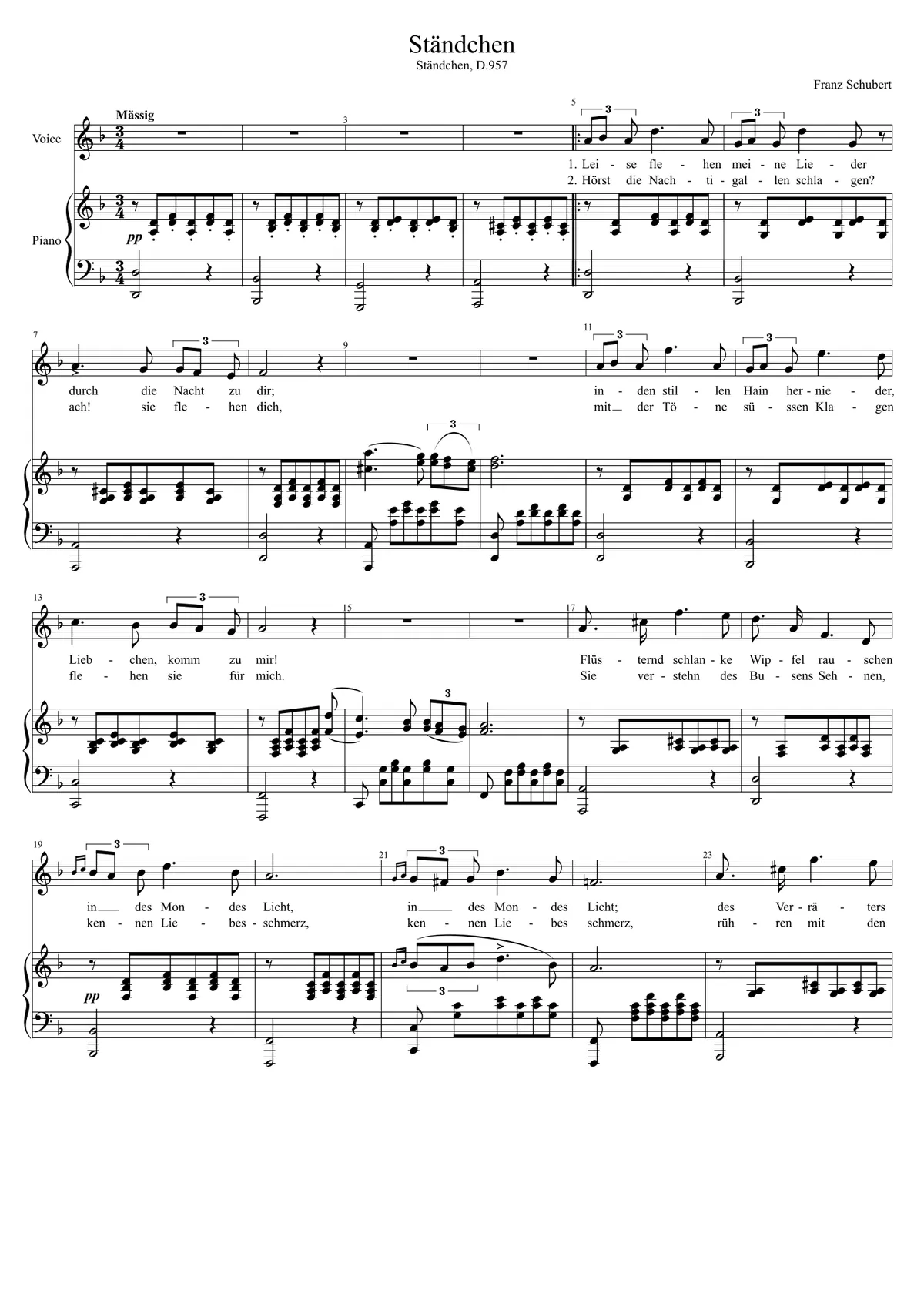
Schubert’s Ständchen (Leise flehen), D.957 No.4: Rellstab text, D minor, voice D4–G5. Notes for piano accompaniment practice.
About the song
Ständchen is the fourth song of Schubert’s Schwanengesang and sets a serenade by Ludwig Rellstab, written in 1828, Schubert’s last year. Schwanengesang is not a cycle Schubert planned: his publisher gathered fourteen late songs after the composer’s death, seven of them to Rellstab texts, and gave the collection its name. The poem opens “Leise flehen meine Lieder durch die Nacht zu dir” (softly my songs plead through the night to you) and asks the beloved to come down into the quiet grove, where the nightingales and the moonlight plead on the singer’s behalf.
Schubert writes it as a guitar serenade: the piano plucks light staccato chords in 3/4 while the voice spins out a long melody, and the piano answers several vocal phrases with an echo of its own. This edition is in D minor and turns to D major for the closing appeal. Because so many listeners know the tune, the interest lies in how simply and intimately it is sung.
What to practice
Keep the triplets of “Leise flehen” and the dotted rhythms that follow clearly different; singers often blur them into one generic lilt. Most of the line lies in the middle of the voice, but the climactic phrases climb toward G5 and need space without pushing the tempo. Plan breaths around the piano’s echoes: each one is a cue to listen, not a gap to fill. In German, give the initial consonants of flehen and Lieder their weight without breaking the legato, and keep the final -en syllables light.
The second stanza repeats the music of the first, which invites a more inward color the second time. When the harmony brightens into D major near the end, resist a big crescendo; the change of mode does the work.
Who it suits
In this edition (D4–G5) it suits medium-high and high voices, especially lyric tenors and sopranos, and works well as a first Schubert song for an undergraduate studio or as a contrasting German selection on an audition list.
Practicing it in Opusis
- Play the piano part on its own and sing over it: choose the voice part and switch to accompaniment practice, and the vocal line drops out.
- Move the song up or down by as much as an octave. The score is redrawn in the new key and the playback follows it.
- Set your own tempo and loop any passage until it sits.
Questions
- What does Leise flehen meine Lieder mean?
- Roughly, “softly my songs plead through the night to you.” The singer is serenading his beloved and begging her to come out and join him.
- Is Schubert’s Ständchen part of a song cycle?
- It is No. 4 of Schwanengesang, D.957, a collection assembled by Schubert’s publisher after his death in 1828 rather than a cycle the composer designed. It is very often sung on its own.
- What key is this Ständchen in?
- This edition is in D minor, ending in D major, with the voice spanning D4 to G5. Publishers also print the song in lower and higher keys for other voice types.
More songs
- Die ForelleFranz Schubert
- Du bist die RuhFranz Schubert
- Gretchen am SpinnradeFranz Schubert
- Lachen und WeinenFranz Schubert
- Der LindenbaumFranz Schubert
- Wandrers Nachtlied II («Über allen Gipfeln»)Franz Schubert