Die Forelle (Franz Schubert) — practice with piano accompaniment
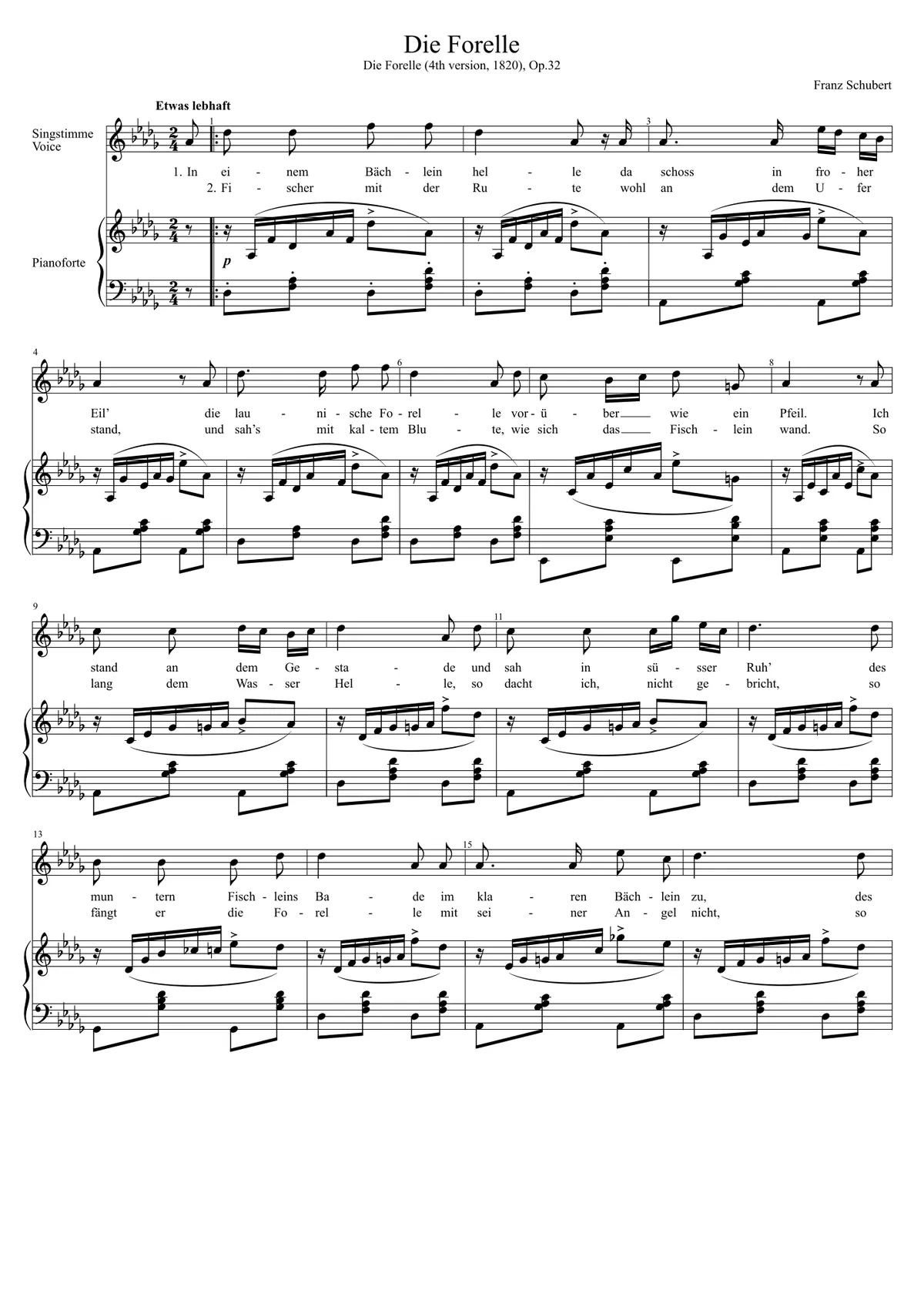
Die Forelle, D. 550, with piano accompaniment: Schubert’s trout song in D♭ major, rippling 2/4 piano part, voice E♭4–G♭5.
About the song
In Christian Friedrich Daniel Schubart’s poem, a narrator on the bank of a clear brook watches a trout dart past like an arrow. The opening, “In einem Bächlein helle, da schoss in froher Eil’,” sets the scene: in a bright little brook, darting in happy haste. A fisherman cannot catch the fish while the water stays clear, so he muddies it, and in a moment the trout is on his line while the narrator looks on, indignant. Schubart’s poem had a further, moralizing stanza aimed at young women; Schubert left it out and let the story speak for itself.
Schubert wrote the song in 1817 and later used its melody as the theme of the variation movement in his Piano Quintet in A, D. 667, the Trout Quintet. The form is modified strophic: two matching verses over a bubbling piano figure, then a third verse that darkens and turns urgent as the water is stirred up, before the opening music comes back to close.
What to practice
The piano’s upward-flicking figure is both the brook and the fish. It must stay light, and the voice should ride on top of it without rushing. Keep the 2/4 buoyant, felt in two, and let the short, syllabic phrases sparkle rather than clip.
The third verse is the real test: the harmony shifts, the storytelling becomes tense, and you need firmer consonants and a darker tone while keeping the narrator’s perspective. Then recover the carefree tone for the close. Five flats can look forbidding, but the line is mostly stepwise and triadic; learn it on a vowel first, then add the German, keeping the final -e of helle and Forelle short and unstressed.
Who it suits
With a range of E♭4–G♭5 in this edition, it suits high voices and is a staple first Schubert song for young sopranos and tenors; mezzos and baritones usually sing it in a lower key.
Practicing it in Opusis
- Play the piano part on its own and sing over it: choose the voice part and switch to accompaniment practice, and the vocal line drops out.
- Move the song up or down by as much as an octave. The score is redrawn in the new key and the playback follows it.
- Set your own tempo and loop any passage until it sits.
Questions
- What is Die Forelle about?
- Die Forelle means The Trout. A narrator watches a trout in a clear stream until a fisherman muddies the water and catches it.
- Is Die Forelle the same melody as the Trout Quintet?
- Yes. Schubert built the theme-and-variations movement of his Piano Quintet in A, D. 667, on this song’s tune, which is how the quintet got its nickname.
- Is Die Forelle strophic?
- Partly. The first two verses share the same music, the third breaks away as the fisherman muddies the water, and the opening music returns at the end.
More songs
- Ständchen («Leise flehen»)Franz Schubert
- Du bist die RuhFranz Schubert
- Gretchen am SpinnradeFranz Schubert
- Lachen und WeinenFranz Schubert
- Der LindenbaumFranz Schubert
- Wandrers Nachtlied II («Über allen Gipfeln»)Franz Schubert