Gretchen am Spinnrade (Franz Schubert) — practice with piano accompaniment
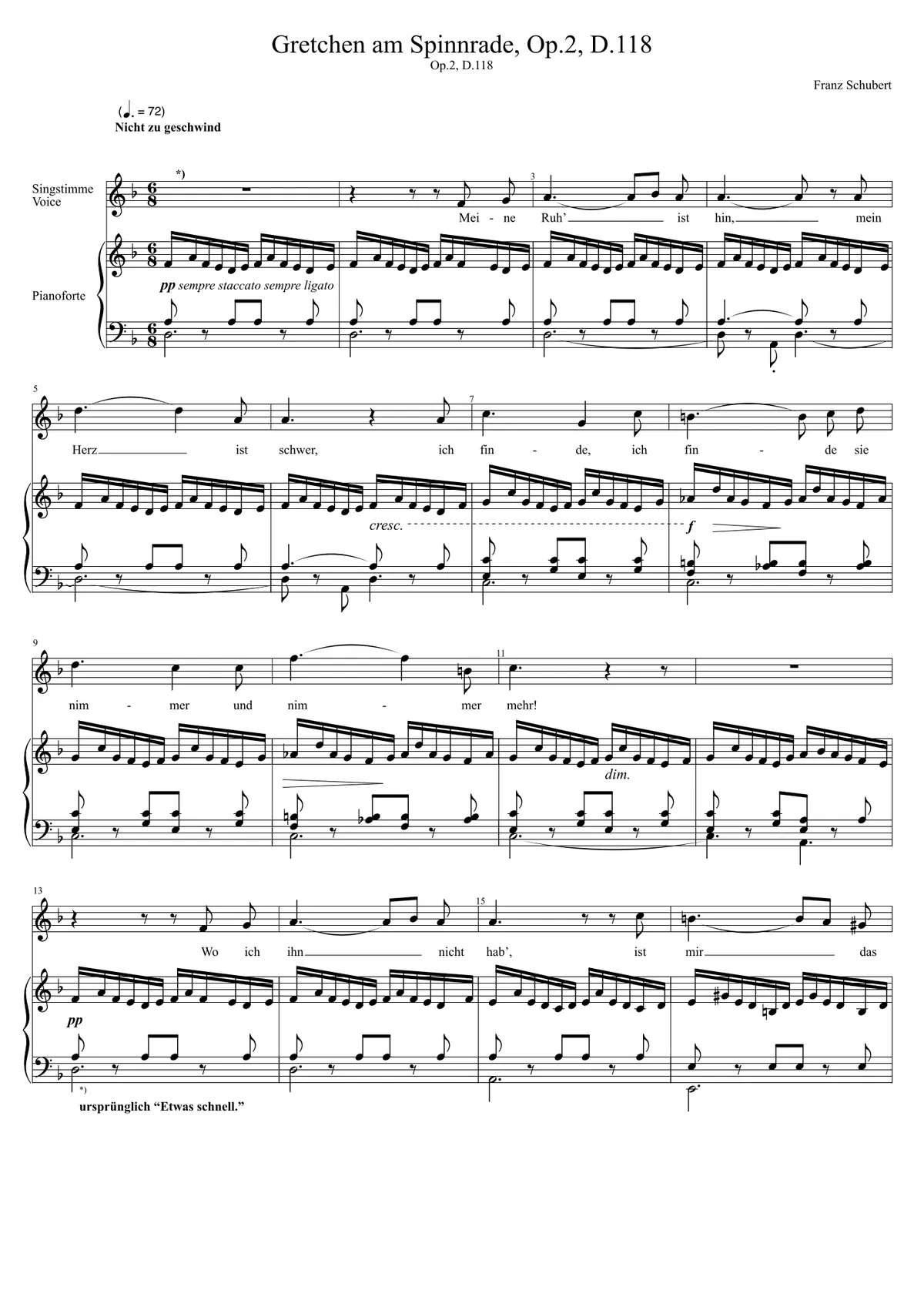
Gretchen am Spinnrade, D. 118, with piano accompaniment: Schubert’s Goethe scene in D minor, spinning-wheel 6/8 figure, voice E4–A5.
About the song
Schubert was seventeen when he wrote Gretchen am Spinnrade in 1814, setting a scene from Goethe’s Faust. Gretchen sits alone at her spinning wheel, thinking of Faust: “Meine Ruh’ ist hin, mein Herz ist schwer” — my peace is gone, my heart is heavy. As she recalls his walk, his smile, the magic of his speech, and finally his kiss, her thoughts spin faster until she loses her composure entirely.
The piano’s unbroken sixteenth-note figure in the right hand is the turning wheel, and the left hand’s repeated rhythm suggests the treadle. The refrain returns again and again, each time from a higher pitch of feeling. At the climax, on “und ach, sein Kuss!”, the spinning stops; when it starts again, haltingly, Gretchen has to collect herself before the refrain. Many regard it as the first great Lied, and it remains a cornerstone of the soprano repertoire.
What to practice
The central challenge is pacing a long, cumulative build over 120 measures. Each refrain must begin softly enough to leave room for the next wave, so map the build-ups and decide where your fullest sound goes; it belongs at the kiss, not before. Keep the 6/8 steady: do not drag in the refrains or rush in the climaxes, because the pianist cannot follow liberties inside the spinning figure.
Rehearse the silence after the climax and the restart with your pianist until it feels shared. Diction must stay crisp at speed: keep the short vowel of hin distinct from the long one of schwer, and make the ch of ach clear but never harsh. Plan breaths well ahead of each climax, since the rising lines cannot be broken.
Who it suits
With a range of E4–A5 here and a sustained upper middle, it suits lyric and spinto sopranos with stamina, and is more often an upper-level undergraduate or graduate audition piece than a first Schubert song.
Practicing it in Opusis
- Play the piano part on its own and sing over it: choose the voice part and switch to accompaniment practice, and the vocal line drops out.
- Move the song up or down by as much as an octave. The score is redrawn in the new key and the playback follows it.
- Set your own tempo and loop any passage until it sits.
Questions
- What scene from Faust does Gretchen am Spinnrade set?
- It sets Gretchen’s monologue at the spinning wheel from Part One of Goethe’s Faust, as she longs for Faust after meeting him.
- How old was Schubert when he composed Gretchen am Spinnrade?
- He was seventeen. The song dates from 1814 and carries the Deutsch catalog number D. 118.
- Can a mezzo-soprano sing Gretchen am Spinnrade?
- Many mezzos sing it in a lower key. In this D minor edition the vocal line reaches A5, which places it with sopranos.
More songs
- Ständchen («Leise flehen»)Franz Schubert
- Die ForelleFranz Schubert
- Du bist die RuhFranz Schubert
- Lachen und WeinenFranz Schubert
- Der LindenbaumFranz Schubert
- Wandrers Nachtlied II («Über allen Gipfeln»)Franz Schubert