Du bist die Ruh (Franz Schubert) — practice with piano accompaniment
Schubert Du bist die Ruh, D. 776: Rückert text, the A♭5 climax, breath and phrasing tips, and piano accompaniment practice in E♭ major.
About the song
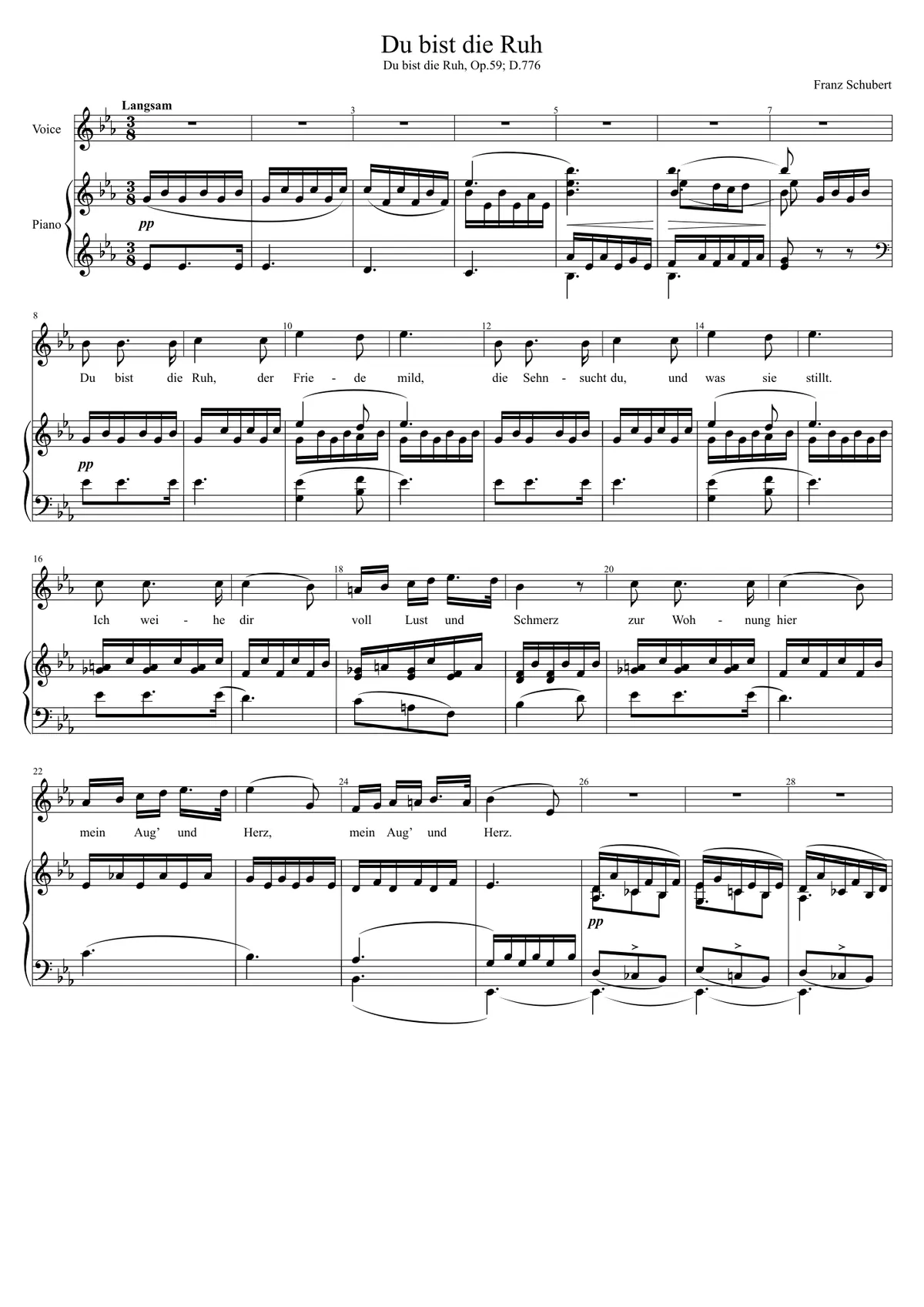
Franz Schubert set Friedrich Rückert’s Du bist die Ruh in 1823. The opening, “Du bist die Ruh, der Friede mild,” addresses the beloved as rest and gentle peace, as longing and what stills it. The speaker dedicates eye and heart to the beloved as a dwelling, asks them to come in and close the gate behind them, and to drive every other pain from this breast. The last stanza asks that this “tent of the eyes,” lit only by the beloved’s radiance, be filled completely.
The song is marked Langsam and stays almost entirely pianissimo over a gently rocking sixteenth-note figure in 3/8. Schubert sets the first two stanzas as one strophe, repeats that music for stanzas three and four, and saves the final stanza for a long crescendo to forte, then a sudden return to pianissimo, and he states that climax twice. It is a staple of studio recitals and a real test of sustained singing.
What to practice
Everything depends on breath management at a slow tempo. Map breaths in advance, especially through “zur Wohnung hier mein Aug’ und Herz,” and resist breathing inside the repeated words.
The famous moment is “Dies Augenzelt von deinem Glanz allein erhellt”: the line climbs under a crescendo to forte and holds A♭5 on “erhellt,” then drops at once to pianissimo for “o füll’ es ganz.” Practice the rise as one long gradual crescendo rather than a jump, and keep the throat free so the A♭ sits on support, not volume. Then rehearse the pianissimo entry right after it, which is harder than the top note. Hear the piano’s seven-bar introduction as setting your tempo; the 3/8 should move in one, not three.
Who it suits
In this edition (E♭4–A♭5) it fits a high voice, lyric soprano or tenor, with secure soft singing; it is a strong upper-level undergraduate or graduate choice rather than a first Lied.
Practicing it in Opusis
- Play the piano part on its own and sing over it: choose the voice part and switch to accompaniment practice, and the vocal line drops out.
- Move the song up or down by as much as an octave. The score is redrawn in the new key and the playback follows it.
- Set your own tempo and loop any passage until it sits.
Questions
- What does Du bist die Ruh mean in English?
- You are rest, or You are peace. The poem addresses the beloved as calm, gentle peace, and both the longing and what satisfies it.
- How hard is Du bist die Ruh to sing?
- Harder than it looks. The notes are simple, but the slow tempo, long pianissimo phrases and the crescendo to a sustained A♭5 followed by an immediate pianissimo demand strong breath control.
- Who wrote the poem for Du bist die Ruh?
- Friedrich Rückert, whose poetry Schubert also set in Lachen und Weinen and other songs from the 1820s.
More songs
- Ständchen («Leise flehen»)Franz Schubert
- Die ForelleFranz Schubert
- Gretchen am SpinnradeFranz Schubert
- Lachen und WeinenFranz Schubert
- Der LindenbaumFranz Schubert
- Wandrers Nachtlied II («Über allen Gipfeln»)Franz Schubert