Der Lindenbaum (Franz Schubert) — practice with piano accompaniment
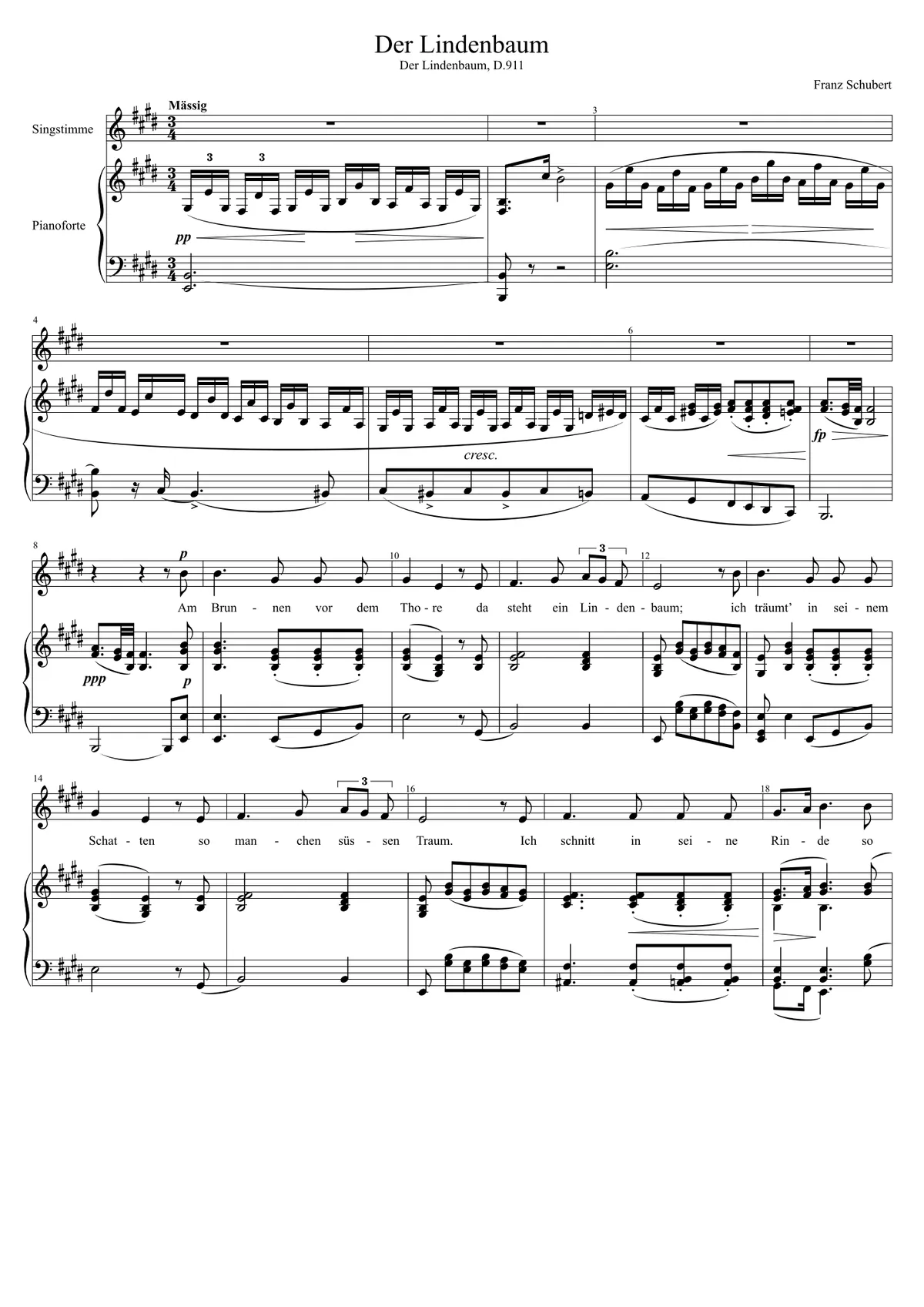
Der Lindenbaum from Winterreise with piano accompaniment: Schubert’s linden-tree song in E major, 3/4, voice B3–E5.
About the song
Der Lindenbaum (The Linden Tree) is the fifth song of Winterreise, Schubert’s cycle of twenty-four poems by Wilhelm Müller. “Am Brunnen vor dem Tore, da steht ein Lindenbaum” — by the well outside the town gate there stands a linden tree. The wanderer remembers dreaming in its shade and carving words of love in its bark. Now, passing it in the dark, he hears its branches rustle as if inviting him to rest there. He turns away into a cold wind that blows his hat off, and hours later he still hears the rustling.
The melody is so folk-like that it took on a life of its own as a popular song, yet Schubert’s setting is far from plain. Rustling triplet figures in the piano frame the verses, the second verse turns to the minor as the wanderer passes in darkness, and a stormy passage of wind follows before the opening tune returns.
What to practice
Treat the opening as a song the wanderer half remembers: simple, even legato, no added sentiment. The real work is contrast. The minor verse needs a darker color without slowing down, and the wind passage needs energy and clear consonants (kalten, Winde, bliesen) over the agitated accompaniment, followed by a complete return to calm.
Sing the 3/4 with a gentle lilt rather than a waltz. The range is moderate, so the risk lies in dynamics: keep the final verse quiet and sustained, with breath to spare for the repeated last line. Rehearse the piano’s triplet passages with your pianist so the changes between sections feel like one continuous landscape.
Who it suits
In this edition (B3–E5) it lies comfortably for tenors, baritones, and mezzo-sopranos, and works well as a first song from Winterreise for undergraduates; bass-baritones often take it lower.
Practicing it in Opusis
- Play the piano part on its own and sing over it: choose the voice part and switch to accompaniment practice, and the vocal line drops out.
- Move the song up or down by as much as an octave. The score is redrawn in the new key and the playback follows it.
- Set your own tempo and loop any passage until it sits.
Questions
- Which number is Der Lindenbaum in Winterreise?
- It is No. 5 of the 24 songs in Winterreise, D. 911.
- What does the linden tree stand for in the song?
- On the surface it is a place of happy memory; its rustling promises the wanderer rest, an offer many listeners hear as a pull toward death.
- Does Der Lindenbaum change key?
- Yes. Written in E major with four sharps, it turns to the minor for the verse in which the wanderer passes the tree in darkness, then returns to the major.
More songs
- FrühlingstraumFranz Schubert
- Der LeiermannFranz Schubert
- Die PostFranz Schubert
- Gute NachtFranz Schubert
- Ständchen («Leise flehen»)Franz Schubert
- Die ForelleFranz Schubert