Der Leiermann (Franz Schubert) — practice with piano accompaniment
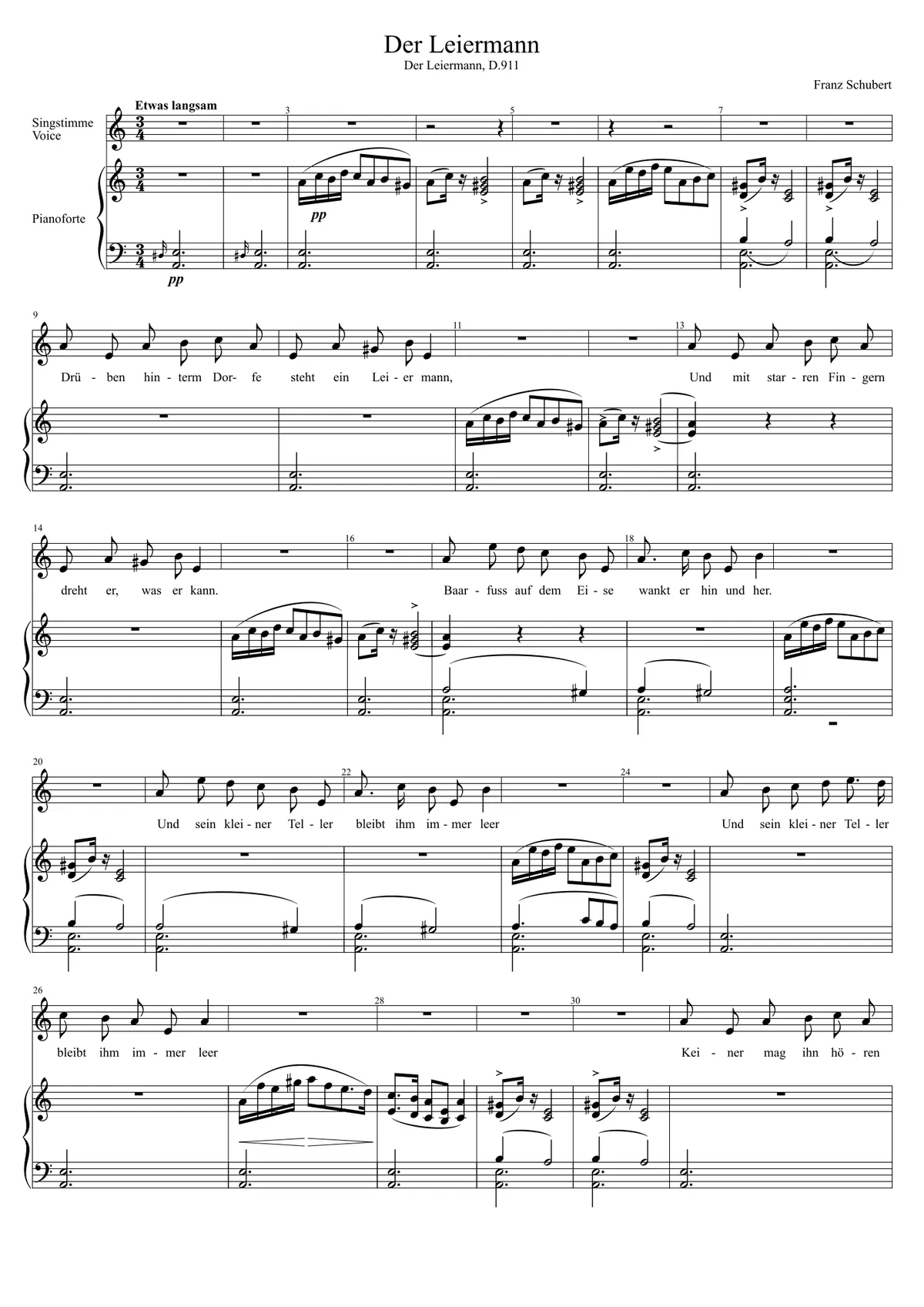
Schubert’s Der Leiermann, the final song of Winterreise: Müller text, A minor, 3/4, voice E4–F5. Practice notes for the piano drone.
About the song
Der Leiermann (The Hurdy-Gurdy Man) is the twenty-fourth and final song of Schubert’s Winterreise, D. 911, on poems by Wilhelm Müller. After a long winter journey through grief, the wanderer comes upon an old street musician: “Drüben hinterm Dorfe steht ein Leiermann” — over there behind the village stands a hurdy-gurdy man. He cranks his instrument barefoot on the ice, his little plate stays empty, no one listens, and the dogs growl at him, yet he lets everything go as it will. The cycle ends with the wanderer asking whether he should go with the old man, and whether he will play his hurdy-gurdy to the wanderer’s songs.
Schubert’s piano part is among the barest in the song repertoire: an open-fifth drone in the left hand, like the hurdy-gurdy’s constant bass, with a small repeating ornamental figure above it. The voice sings short, plain phrases that take turns with the piano’s refrain. With no key signature and the drone held under almost the whole song, the effect is stillness rather than development.
What to practice
The difficulty is restraint. Keep the tone plain, without swelling into each note, and let the German consonants and the words do the expressing; this is a narrator observing, not lamenting. Count carefully: voice and piano alternate, and the exchange must sit in a steady 3/4 without rubato that would sentimentalize it. The range, E4 to F5, is moderate, so the real work is sustaining soft singing with full support. Decide how the last stanza, the wanderer’s direct address to the old man, changes color, and keep it from turning operatic. Rehearse the final phrase and the silence after it; the song ends only when the piano does.
Who it suits
In this edition (E4–F5) it suits tenors and sopranos, or mezzos with an easy top; as a standalone song it fits advanced undergraduates and graduate singers who can sustain quiet intensity.
Practicing it in Opusis
- Play the piano part on its own and sing over it: choose the voice part and switch to accompaniment practice, and the vocal line drops out.
- Move the song up or down by as much as an octave. The score is redrawn in the new key and the playback follows it.
- Set your own tempo and loop any passage until it sits.
Questions
- What is a Leiermann?
- A Leiermann is a hurdy-gurdy player, a street musician who turns a crank to sound strings over a constant drone. Schubert imitates that drone with open fifths in the piano.
- Can Der Leiermann be sung outside Winterreise?
- Yes. It is often sung alone in studio classes and recitals, though it carries extra weight as the last song of the cycle.
- What happens at the end of Der Leiermann?
- The wanderer asks the old man whether he may go along with him and whether he will play to the wanderer’s songs. The question is left unanswered, and the cycle ends there.
More songs
- Der LindenbaumFranz Schubert
- FrühlingstraumFranz Schubert
- Die PostFranz Schubert
- Gute NachtFranz Schubert
- Ständchen («Leise flehen»)Franz Schubert
- Die ForelleFranz Schubert