Frühlingstraum (Franz Schubert) — practice with piano accompaniment
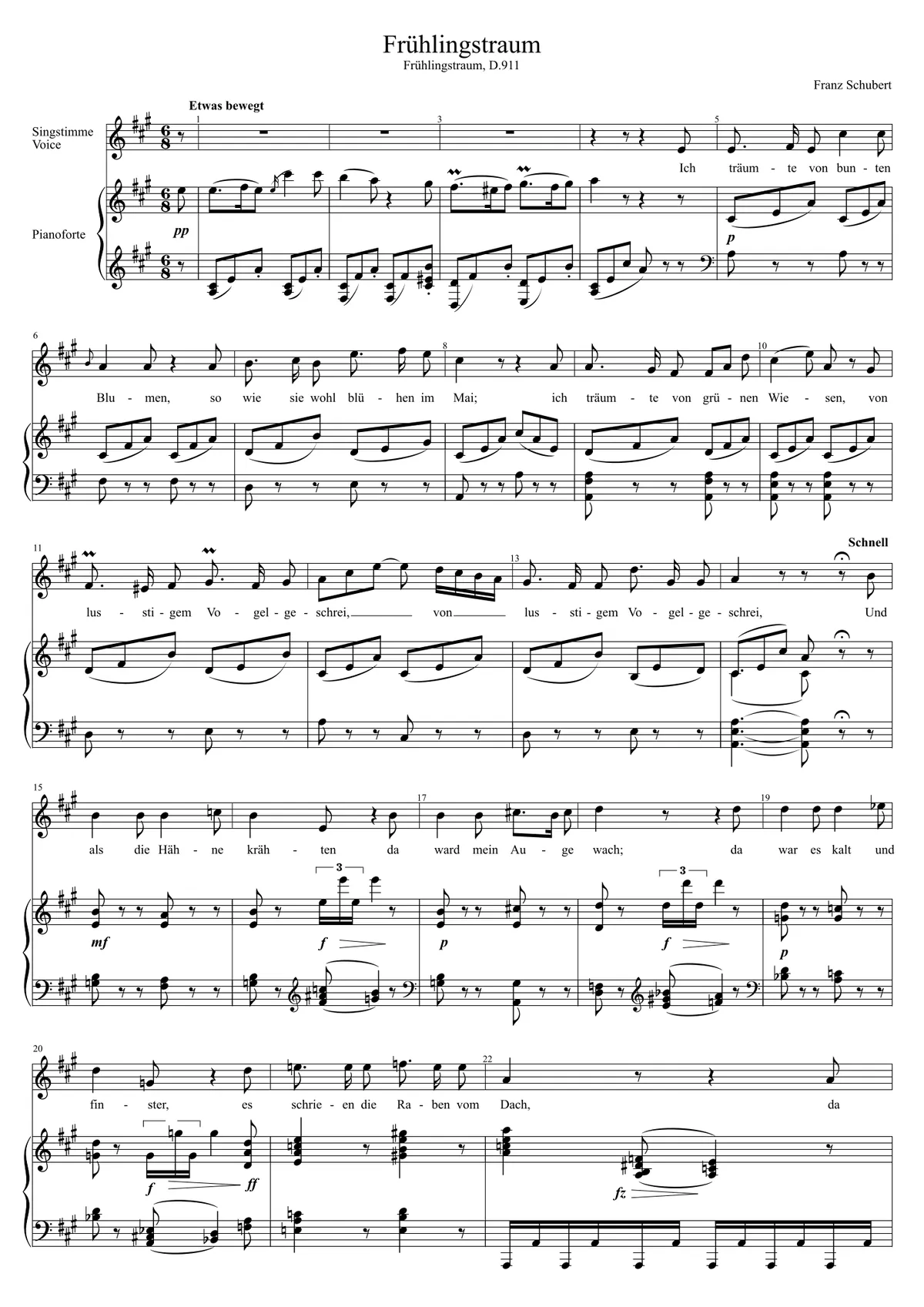
Frühlingstraum from Winterreise with piano accompaniment: Schubert’s dream of spring in A major, three contrasting moods, voice E4–F♯5.
About the song
Frühlingstraum (Dream of Spring) is the eleventh song of Winterreise. The wanderer dreams of bright flowers, “Ich träumte von bunten Blumen, so wie sie wohl blühen im Mai” — I dreamed of colorful flowers, the way they bloom in May — of green meadows and birdsong. Then the cocks crow, he wakes to cold and darkness, and the only leaves he sees are frost patterns on the windowpane. He asks who painted them and imagines being laughed at as a dreamer who saw flowers in winter.
Schubert sets each half of the poem as a chain of three sharply different musics: a gentle, rocking 6/8 dream in A major, an abrupt and harsh awakening, and a slow, sorrowful reflection. The chain is heard twice, and the song ends not in the dream’s major but in A minor, with the question of when he will hold his love again left hanging.
What to practice
This song is a study in instant changes of character. Practice the three sections separately until each has its own tempo and color, then rehearse the joins, because the switches are sudden and your pianist must catch the new tempo at once. The dream should be light and tender, never sugary. The waking section needs crisp attacks and clear consonants (Hähne, krähten, schrien) without forcing.
The slow section is the hardest: long, quiet phrases over exposed harmonies that test intonation and breath support. Because the sequence repeats, do not make the second pass a copy; let the dream sound more fragile the second time, since the singer now knows how it ends.
Who it suits
With a range of E4–F♯5 in this edition, it suits tenors and high baritones, as well as sopranos and mezzos who sing Winterreise, and works for advanced undergraduates who can handle quick shifts of mood.
Practicing it in Opusis
- Play the piano part on its own and sing over it: choose the voice part and switch to accompaniment practice, and the vocal line drops out.
- Move the song up or down by as much as an octave. The score is redrawn in the new key and the playback follows it.
- Set your own tempo and loop any passage until it sits.
Questions
- What happens in Frühlingstraum?
- The wanderer dreams of spring flowers and love, wakes to crowing roosters and frost on the window, and closes his eyes again, asking when the leaves on the window will turn green.
- Why does Frühlingstraum keep changing tempo?
- Schubert gives the dream, the awakening, and the waking reflection their own tempo and texture, then repeats that sequence for the second half of the poem.
- Does Frühlingstraum end in major or minor?
- It begins in A major and ends in A minor; the key signature of three sharps stays the same throughout this edition.
More songs
- Der LindenbaumFranz Schubert
- Der LeiermannFranz Schubert
- Die PostFranz Schubert
- Gute NachtFranz Schubert
- Ständchen («Leise flehen»)Franz Schubert
- Die ForelleFranz Schubert