Die Post (Franz Schubert) — practice with piano accompaniment
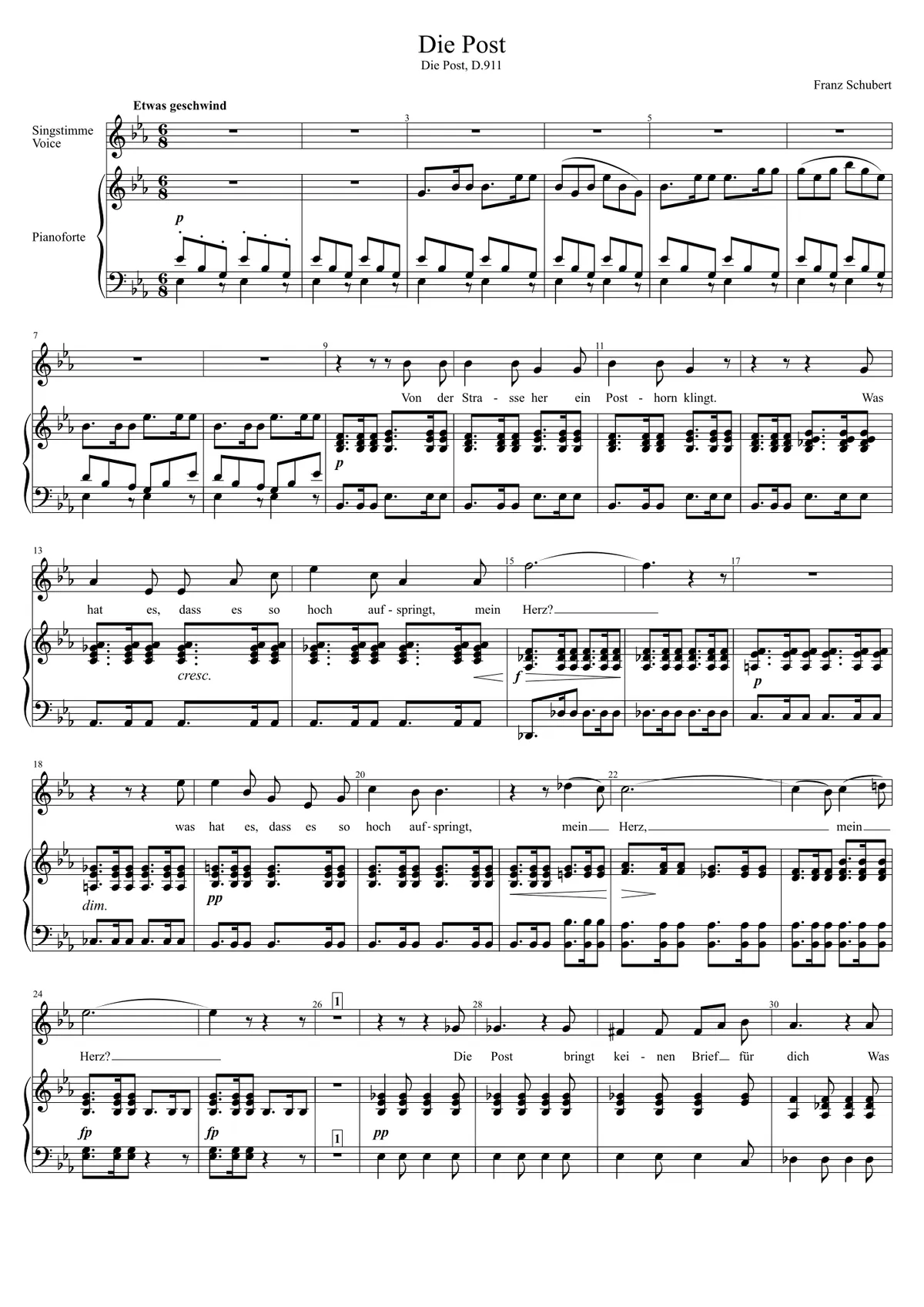
Schubert’s Die Post, D.911 No.13 from Winterreise: Müller text, E♭ major, 6/8, voice E♭4–A♭5. Practice notes with the posthorn piano part.
About the song
Die Post (The Post) is the thirteenth song of Schubert’s Winterreise and opens the cycle’s second part. Wilhelm Müller’s wanderer hears a mail coach: “Von der Straße her ein Posthorn klingt” — from the road a posthorn sounds — and asks his heart why it leaps so high. The answer is bitter: the post brings no letter for him. Yet the coach comes from the town where his beloved lives, and his heart longs to look back and ask how things are there.
Schubert builds the song on the coach and its horn. The piano sets off with a trotting dotted rhythm in 6/8 and horn-call figures in E♭ major, an unusually bright sound for this cycle. When the wanderer admits no letter is coming, the music clouds over before the excitement returns. Lively, dramatically clear and easy to excerpt, it is one of the Winterreise songs most often sung on its own.
What to practice
In this edition the voice runs from E♭4 to A♭5, and the repeated cries of “mein Herz” need ring without being shouted. Keep the 6/8 in two strong beats and let the piano’s hoofbeat rhythm set the tempo; singers who rush the excitement crowd their own consonants. German diction has to stay clear at speed: the sharp s in Straße, the clustered consonants of klingt and aufspringt, and every final t. Contrast drives the song, so give the hopeful questions energy and the moment of realization a sudden drop in color. Learn the piano interludes along with your own part so each entry lands on the beat.
Who it suits
In this edition (E♭4–A♭5) it suits tenors and lyric sopranos with a secure top, and it is a lively, accessible Winterreise excerpt for an undergraduate jury or audition.
Practicing it in Opusis
- Play the piano part on its own and sing over it: choose the voice part and switch to accompaniment practice, and the vocal line drops out.
- Move the song up or down by as much as an octave. The score is redrawn in the new key and the playback follows it.
- Set your own tempo and loop any passage until it sits.
Questions
- What does Die Post mean in Winterreise?
- It means “the post,” the mail coach. The wanderer hears its horn, hopes for a letter, and realizes none will come, even though the coach arrives from his beloved’s town.
- Where does Die Post fall in Winterreise?
- It is No. 13 of 24 and begins the second part of the cycle, which Schubert composed after the first twelve songs.
- Is Die Post a good audition piece?
- It is popular for auditions because it is energetic, has a clear dramatic turn and shows German diction at speed. Make sure the top of the range, up to A♭5 in this edition, is comfortable.
More songs
- Der LindenbaumFranz Schubert
- FrühlingstraumFranz Schubert
- Der LeiermannFranz Schubert
- Gute NachtFranz Schubert
- Ständchen («Leise flehen»)Franz Schubert
- Die ForelleFranz Schubert