Gute Nacht (Franz Schubert) — practice with piano accompaniment
Schubert Gute Nacht, D. 911 No. 1, opening song of Winterreise: Müller text, pacing four stanzas, and piano accompaniment practice in D minor.
About the song
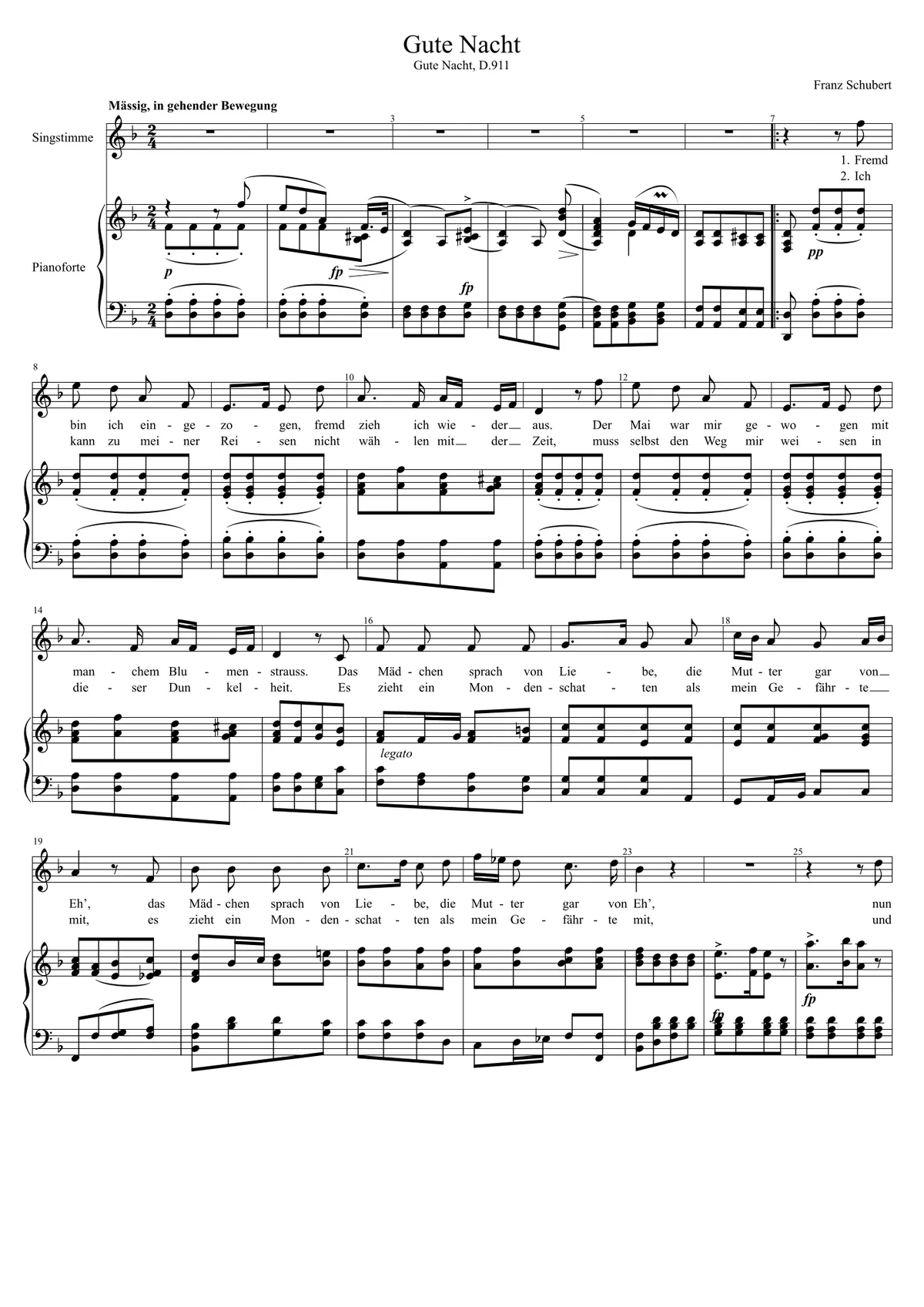
Gute Nacht (Good Night) opens Winterreise, D. 911, Franz Schubert’s 1827 cycle of 24 songs on poems by Wilhelm Müller. The first line, “Fremd bin ich eingezogen, fremd zieh ich wieder aus,” sets the tone of the cycle: I arrived a stranger, and a stranger I leave. In May the girl spoke of love and her mother even of marriage; now the world is gray and the road is covered in snow. He will not linger to be driven out; he sets out at night and writes “good night” on her gate as he passes so she will know he thought of her.
Schubert sets it as a walk, marked Mässig, in gehender Bewegung, with steady eighth-note chords that carry the singer’s footsteps through the song. The first two stanzas share the same music, the third grows bitterer, and the fourth turns from D minor to D major, pianissimo, for “Will dich im Traum nicht stören,” before the postlude returns to minor.
What to practice
Find a walking tempo you and the pianist can sustain across all four stanzas and 105 bars; the eighths must be even but never mechanical. Pace the dynamics: much of the song is p and pp, with the fp accents in the piano doing the expressive work.
The range is wide in this edition, A3 to F♯5, and the F♯5s come in the major stanza, on words like “Ruh” and “sehen,” where they must stay soft. Practice those phrases at pianissimo first. Make the move to major a real change of color, tender rather than happy, and keep the repeated “an dich hab’ ich gedacht” intimate. Müller’s text is direct and narrative, so give the consonants of “Fremd,” “Schnee” and “Schatten” time to speak.
Who it suits
This edition (A3–F♯5) suits tenor and high baritone, and lyric mezzos who sing the cycle. It is usually advanced undergraduate or graduate repertoire, often studied as the gateway to the whole of Winterreise.
Practicing it in Opusis
- Play the piano part on its own and sing over it: choose the voice part and switch to accompaniment practice, and the vocal line drops out.
- Move the song up or down by as much as an octave. The score is redrawn in the new key and the playback follows it.
- Set your own tempo and loop any passage until it sits.
Questions
- What is the first song of Winterreise?
- Gute Nacht, D. 911 No. 1. It introduces the wanderer who leaves his beloved’s town at night in winter.
- Why does Gute Nacht change key?
- The last stanza moves from D minor to D major as the wanderer turns tender and decides not to wake her; the minor returns in the piano postlude.
- What does the title Gute Nacht refer to?
- Leaving town at night, the wanderer writes “Gute Nacht,” good night, on his beloved’s gate as he passes, so she will know he thought of her.
More songs
- Der LindenbaumFranz Schubert
- FrühlingstraumFranz Schubert
- Der LeiermannFranz Schubert
- Die PostFranz Schubert
- Ständchen («Leise flehen»)Franz Schubert
- Die ForelleFranz Schubert