Lachen und Weinen (Franz Schubert) — practice with piano accompaniment
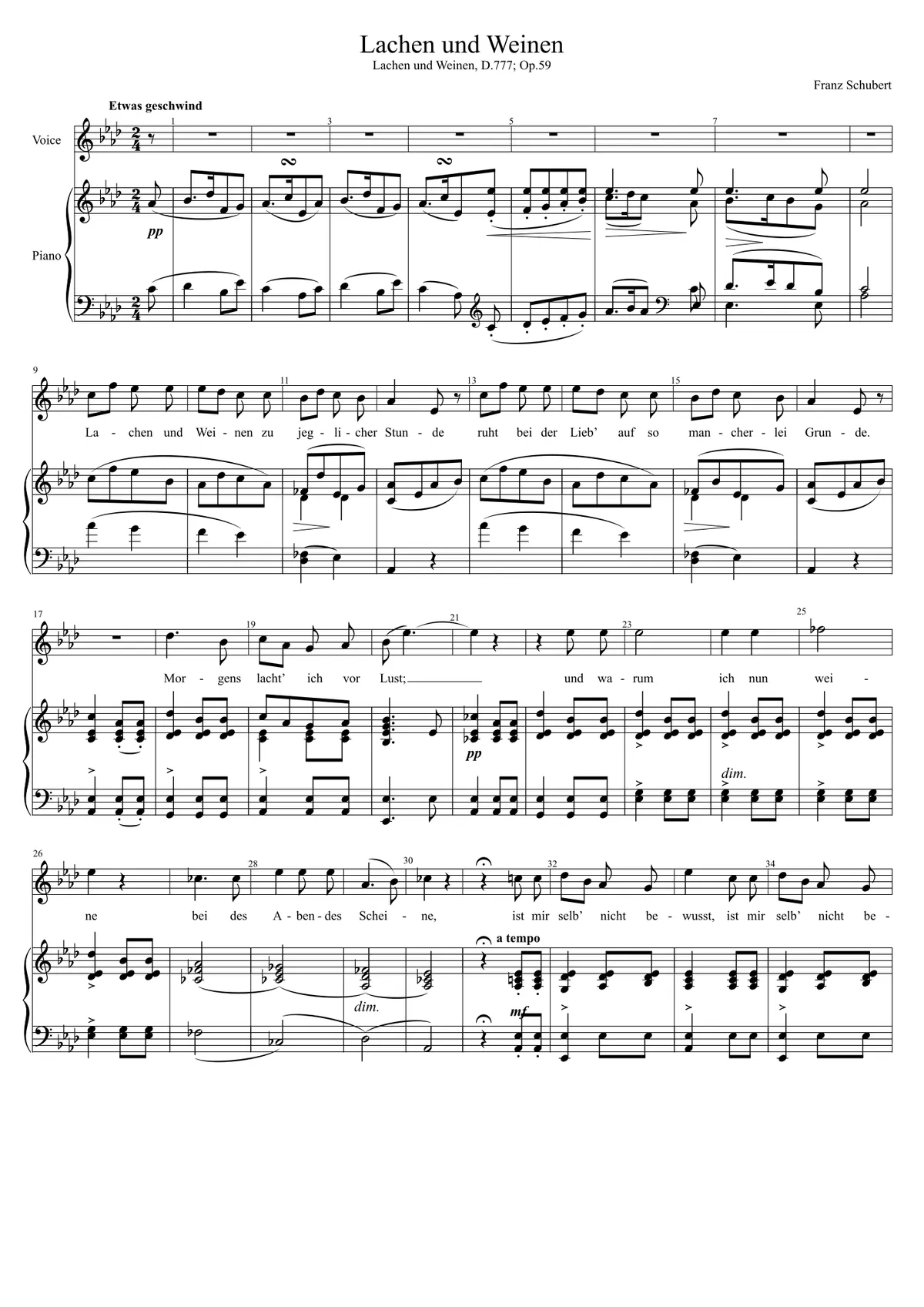
Schubert Lachen und Weinen, D. 777, on Rückert: light-voice diction and phrasing notes, and piano accompaniment practice in A♭ major, 2/4.
About the song
Lachen und Weinen (Laughing and Weeping) is Franz Schubert’s setting of a short poem by Friedrich Rückert. It opens “Lachen und Weinen zu jeglicher Stunde ruht bei der Lieb’ auf so mancherlei Grunde”: in love, laughter and tears at any hour can rest on all sorts of reasons. In the morning the speaker laughed for joy; why weep now in the evening glow? He does not know himself. The second stanza reverses the order, weeping in the evening and waking to laughter in the morning, and ends by putting the question to the heart.
Schubert keeps it quick and light, marked Etwas geschwind, with an airy piano part and swift changes of mood as the text moves between joy and sorrow. Each stanza is followed by a piano interlude. Singers like it as a bright contrast in a Schubert group, and it shows charm and nimble German without heavy demands.
What to practice
Keep the voice light and the consonants quick so the 2/4 never feels heavy; think of the eighth-note pulse as a dance, and listen for how the piano shifts color when the text turns to tears.
The two stanzas mirror each other, so make the contrast clear. Note the pianissimo openings, the diminuendo into “bei des Abendes Scheine,” and the a tempo at mf for “ist mir selb’ nicht bewusst.” In the second stanza, the crescendo at “und warum du erwachen kannst” leads to the song’s top note, G♭5, on “Morgen mit Lachen.” Sing it with a smile rather than weight. Then pace the repeated “muss ich dich fragen, o Herz” so the final question sounds genuinely unresolved.
Who it suits
Spanning E♭4 to G♭5 in this edition, it suits light high voices, soubrette or lyric soprano and light tenor, and makes a good second or third Schubert song for undergraduates.
Practicing it in Opusis
- Play the piano part on its own and sing over it: choose the voice part and switch to accompaniment practice, and the vocal line drops out.
- Move the song up or down by as much as an octave. The score is redrawn in the new key and the playback follows it.
- Set your own tempo and loop any passage until it sits.
Questions
- What does Lachen und Weinen mean?
- Laughing and Weeping. The poem observes that in love both can come at any hour, for reasons the speaker cannot explain.
- What tempo is Lachen und Weinen?
- Schubert marks it Etwas geschwind, somewhat fast, in 2/4. Keep it light and moving so the quick shifts between joy and sorrow stay playful.
More songs
- Ständchen («Leise flehen»)Franz Schubert
- Die ForelleFranz Schubert
- Du bist die RuhFranz Schubert
- Gretchen am SpinnradeFranz Schubert
- Der LindenbaumFranz Schubert
- Wandrers Nachtlied II («Über allen Gipfeln»)Franz Schubert