Auf dem Wasser zu singen (Franz Schubert) — practice with piano accompaniment
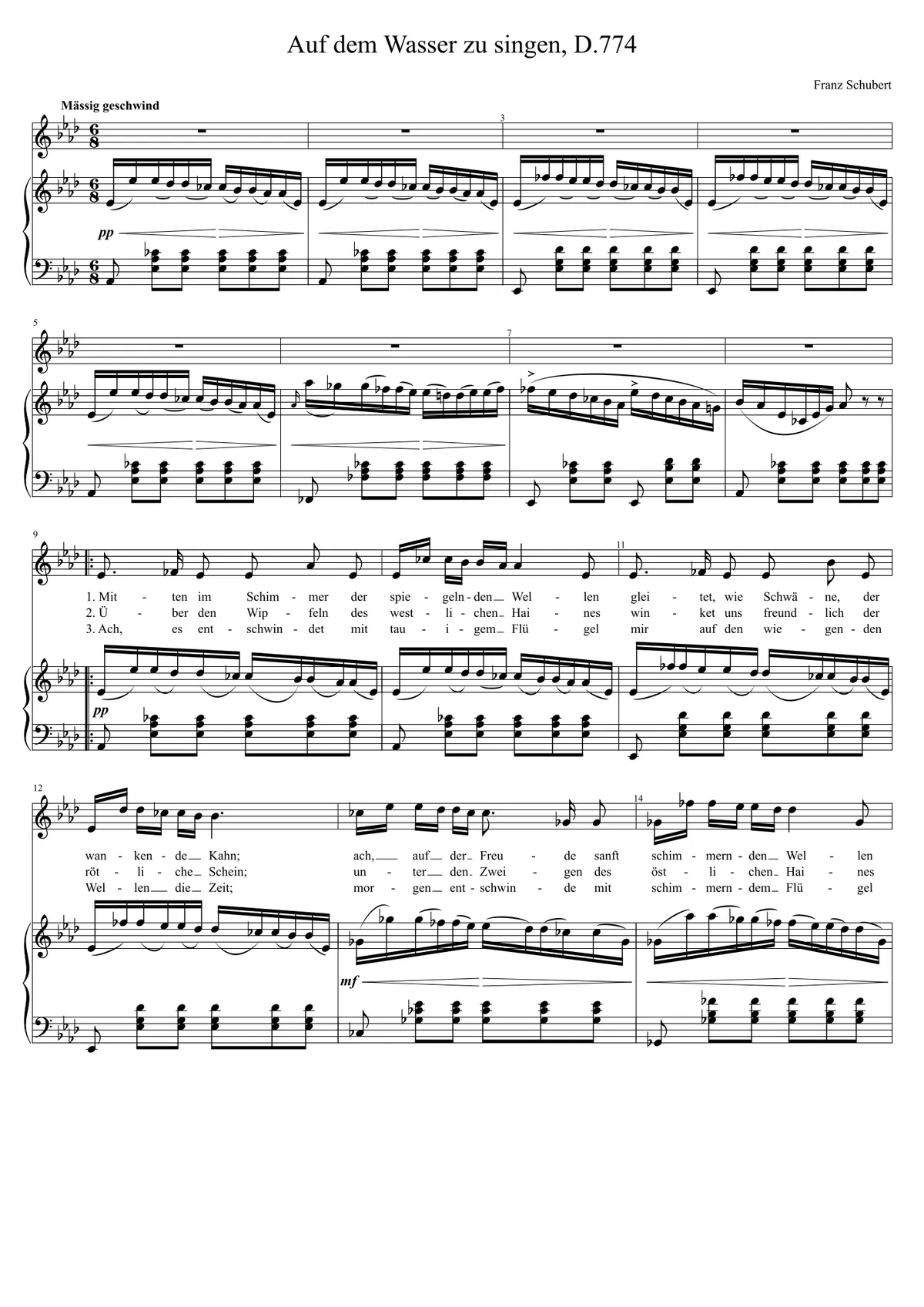
Schubert Auf dem Wasser zu singen, D. 774 (Stolberg): three-verse strophic song, diction and line tips, and piano accompaniment practice in A♭.
About the song
Auf dem Wasser zu singen (To Be Sung on the Water) sets a poem by Friedrich Leopold zu Stolberg-Stolberg. It opens “Mitten im Schimmer der spiegelnden Wellen gleitet, wie Schwäne, der wankende Kahn”: amid the shimmer of the mirroring waves, the rocking boat glides like a swan. The second verse watches the red evening glow beckoning over the treetops of the western grove. The third turns to time itself, which slips away on dewy wings over the waves, until the speaker too will vanish from changing time on higher, radiant wings.
Schubert sets all three verses to the same music, marked Mässig geschwind, in 6/8. The piano’s rippling sixteenth-note figure, falling in repeated pairs, depicts the light on the water, while the voice rides above it in long, rocking phrases. It is one of Schubert’s best-loved songs, a recital favorite and a showpiece for the pianist.
What to practice
Feel the 6/8 in two, and let the voice float above the piano’s ripple without rushing it; the voice should carry the long line, the piano the motion. Begin pianissimo and save the rise to G♭5 for the phrase “denn von dem Himmel herab” and its counterparts in later verses.
Strophic songs need a plan. The notes stay the same, so color each verse by its text: the first calm and visual, the second warmer with the evening glow, the third more reflective as it speaks of time and death. German clusters such as “spiegelnden,” “schimmernden” and “entschwindet” come quickly at this tempo; practice them spoken in rhythm until the consonants are light and the vowels stay long.
Who it suits
In this edition the voice spans E♭4–G♭5, so it suits soprano or tenor with an easy upper middle; it is a good choice for upper-level undergraduates who can sustain a smooth legato.
Practicing it in Opusis
- Play the piano part on its own and sing over it: choose the voice part and switch to accompaniment practice, and the vocal line drops out.
- Move the song up or down by as much as an octave. The score is redrawn in the new key and the playback follows it.
- Set your own tempo and loop any passage until it sits.
Questions
- What does Auf dem Wasser zu singen mean?
- To Be Sung on the Water. The poem describes a boat gliding on shimmering evening waves and moves on to time slipping away.
- How many verses does Auf dem Wasser zu singen have?
- Three, all sung to the same music. This edition prints one strophe with the three verses of text stacked underneath.
- Is the piano part difficult?
- Yes. The constant sixteenth-note figure is one of the more demanding Schubert accompaniments, so collaborative pianists usually need their own preparation time.
More songs
- Ständchen («Leise flehen»)Franz Schubert
- Die ForelleFranz Schubert
- Du bist die RuhFranz Schubert
- Gretchen am SpinnradeFranz Schubert
- Lachen und WeinenFranz Schubert
- Der LindenbaumFranz Schubert