Waldesgespräch (Robert Schumann) — practice with piano accompaniment
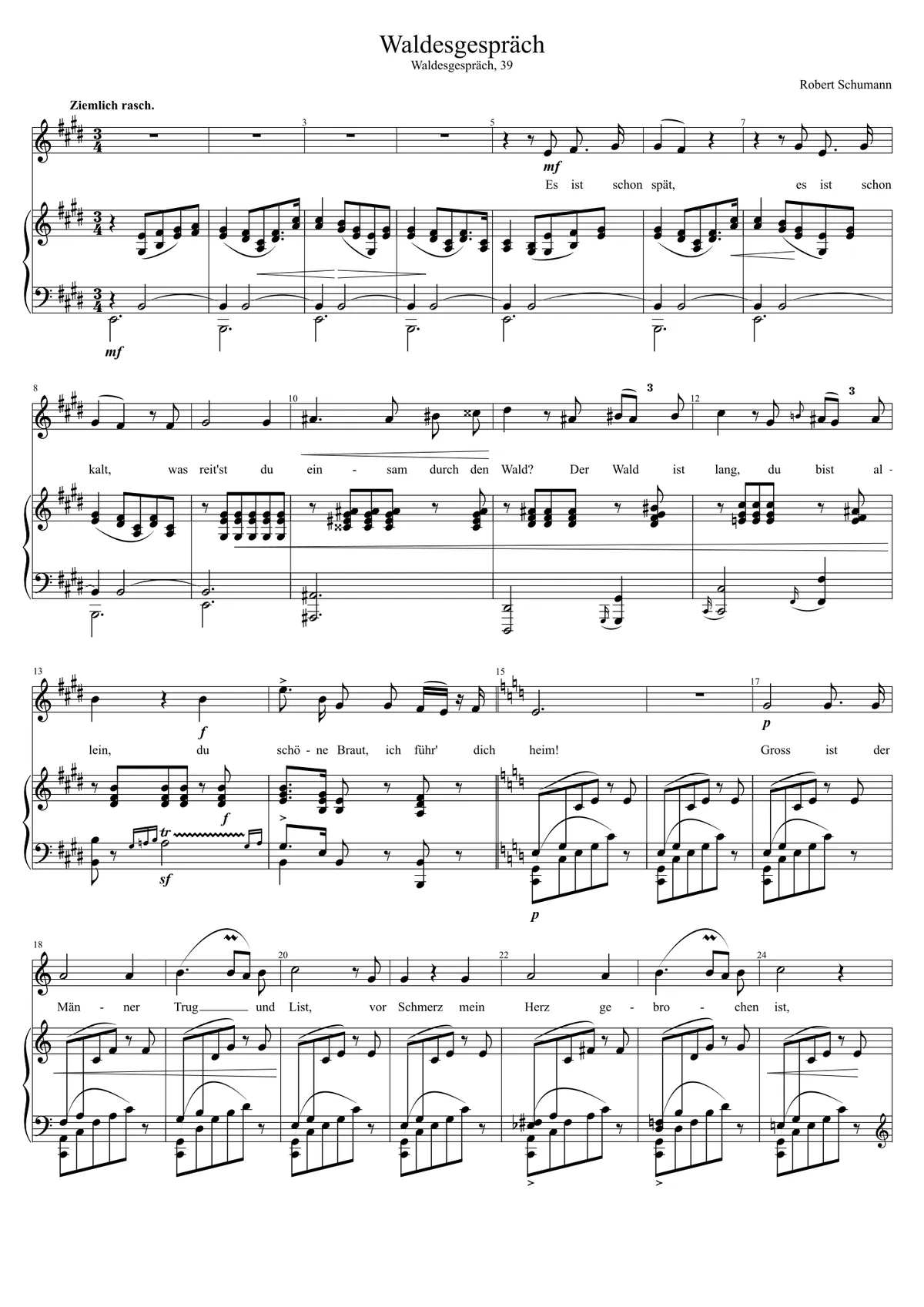
Schumann’s Waldesgespräch, Op. 39 No. 3, with piano accompaniment: Eichendorff’s Lorelei ballad in E major, 3/4, voice B3–G♯5.
About the song
Waldesgespräch (Conversation in the Forest) is the third song of Schumann’s Liederkreis, Op. 39, his 1840 cycle on poems by Joseph von Eichendorff. A horseman meets a woman riding alone at nightfall: “Es ist schon spät, es ist schon kalt, was reit’st du einsam durch den Wald?” — it is late, it is cold, why ride alone through the forest? He offers to lead her home. She warns him that men’s deceit has broken her heart; then he recognizes her as the witch Lorelei, and she turns his own opening words back on him: it is late, it is cold, and he will never leave this forest.
One singer plays both characters. Schumann gives the man a hearty accompaniment with the ring of hunting horns and sets the Lorelei’s reply in a different key, softer and more spacious, so the listener hears the change of speaker before a word is sung.
What to practice
The song lives on characterization. Decide on two distinct colors, the man direct and a little brash, the Lorelei smoother and more veiled, and let the piano’s change of texture cue each switch. Keep the man’s phrases rhythmically firm so the Lorelei’s broader lines can contrast.
The range is wide, reaching G♯5 in this edition, so practice the higher phrases at full length rather than in isolation, keeping the vowel open and the throat relaxed. Eichendorff’s compact lines are full of consonant clusters (reit’st, kalt, Wald); make them crisp but light. Plan the last stanza with care: the Lorelei repeats the man’s own words, and the menace comes from how you color them, not from extra volume.
Who it suits
With a range of B3–G♯5 in this edition, it suits sopranos and tenors with a solid lower middle, while mezzos and baritones commonly sing it in a lower key. It is a strong audition choice for showing dramatic storytelling in a short song.
Practicing it in Opusis
- Play the piano part on its own and sing over it: choose the voice part and switch to accompaniment practice, and the vocal line drops out.
- Move the song up or down by as much as an octave. The score is redrawn in the new key and the playback follows it.
- Set your own tempo and loop any passage until it sits.
Questions
- Who are the two characters in Waldesgespräch?
- A man riding through the forest and the Lorelei, the enchantress of Rhine legend. A single singer performs both.
- Which cycle is Waldesgespräch from?
- It is No. 3 of Schumann’s Liederkreis, Op. 39, twelve songs on Eichendorff poems composed in 1840.
- What does the title Waldesgespräch mean?
- Conversation in the Forest. It refers to the exchange between the horseman and the Lorelei, both sung by the same performer.
More songs
- In der FremdeRobert Schumann
- MondnachtRobert Schumann
- IntermezzoRobert Schumann
- WidmungRobert Schumann
- Der NussbaumRobert Schumann
- Du bist wie eine BlumeRobert Schumann