In der Fremde (Robert Schumann) — practice with piano accompaniment
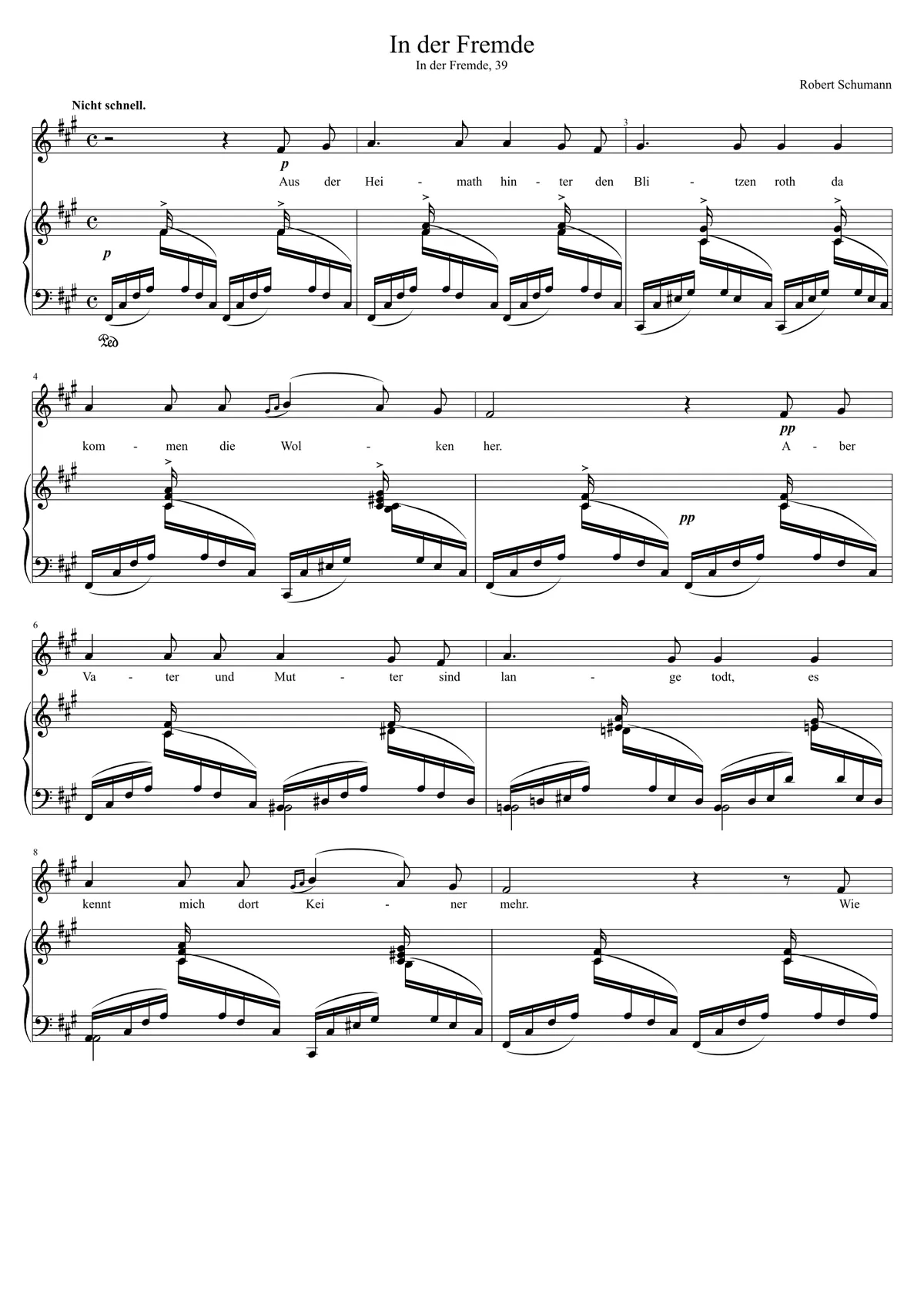
Schumann In der Fremde, Op. 39 No. 1, on Eichendorff: what the song is about, practice notes, and piano accompaniment practice in F♯ minor.
About the song
In der Fremde (In a Foreign Land) opens Robert Schumann’s Liederkreis, Op. 39, the 1840 cycle of twelve Joseph von Eichendorff poems. The first line, “Aus der Heimat hinter den Blitzen rot,” looks back toward home, beyond the red lightning, where the clouds come from. There is nothing left there: father and mother are long dead, and no one there knows the speaker anymore. The second half turns to the quiet time that is coming, when he too will rest under the rustling forest solitude, the Waldeinsamkeit so central to Eichendorff, and no one here will know him either.
Schumann sets it in just 28 bars in F♯ minor, marked Nicht schnell, over a continuous broken-chord figure in the piano. The voice never leaves the staff. That restraint is why singers program it: it opens the cycle in a hushed, inward key and shows text sense and line rather than volume.
What to practice
The challenge is color, not range. Start at the marked piano and let the legato float over the piano’s even sixteenths without pressing each beat; the figure should feel like motion under you, not a metronome. The one E5 lands on “auch” in “da ruhe ich auch,” a word of resignation, so arrive there gently rather than with a push.
Eichendorff’s repetitions carry the second half: “die schöne Waldeinsamkeit” and “und Keiner kennt mich mehr hier” each come twice. Shape the second statement differently, usually quieter and more inward. Watch the closed German vowels in “ruhe,” “schöne” and “über,” and keep the final r’s of “mehr hier” light so the ending stays soft.
Who it suits
With a compact E4–E5 range in this edition, it suits medium voices, mezzo-soprano and baritone especially, and works as a first Schumann song for undergraduates who already sing a clean German legato.
Practicing it in Opusis
- Play the piano part on its own and sing over it: choose the voice part and switch to accompaniment practice, and the vocal line drops out.
- Move the song up or down by as much as an octave. The score is redrawn in the new key and the playback follows it.
- Set your own tempo and loop any passage until it sits.
Questions
- What does In der Fremde mean?
- It means In a Foreign Land, or Abroad. The speaker is far from a home where no one remembers him and looks ahead to his own rest in the forest.
- Isn’t there another song called In der Fremde in Liederkreis Op. 39?
- Yes. No. 8 has the same title but a different Eichendorff poem, beginning “Ich hör’ die Bächlein rauschen.” This page is No. 1, the song that opens the cycle.
- What is the piano part like in In der Fremde?
- A broken-chord figure in even sixteenth notes runs under the voice through the song, giving it a quiet, flowing motion. The singer’s job is to keep a long legato line above it rather than following each note.
More songs
- MondnachtRobert Schumann
- IntermezzoRobert Schumann
- WaldesgesprächRobert Schumann
- WidmungRobert Schumann
- Der NussbaumRobert Schumann
- Du bist wie eine BlumeRobert Schumann