Mondnacht (Robert Schumann) — practice with piano accompaniment
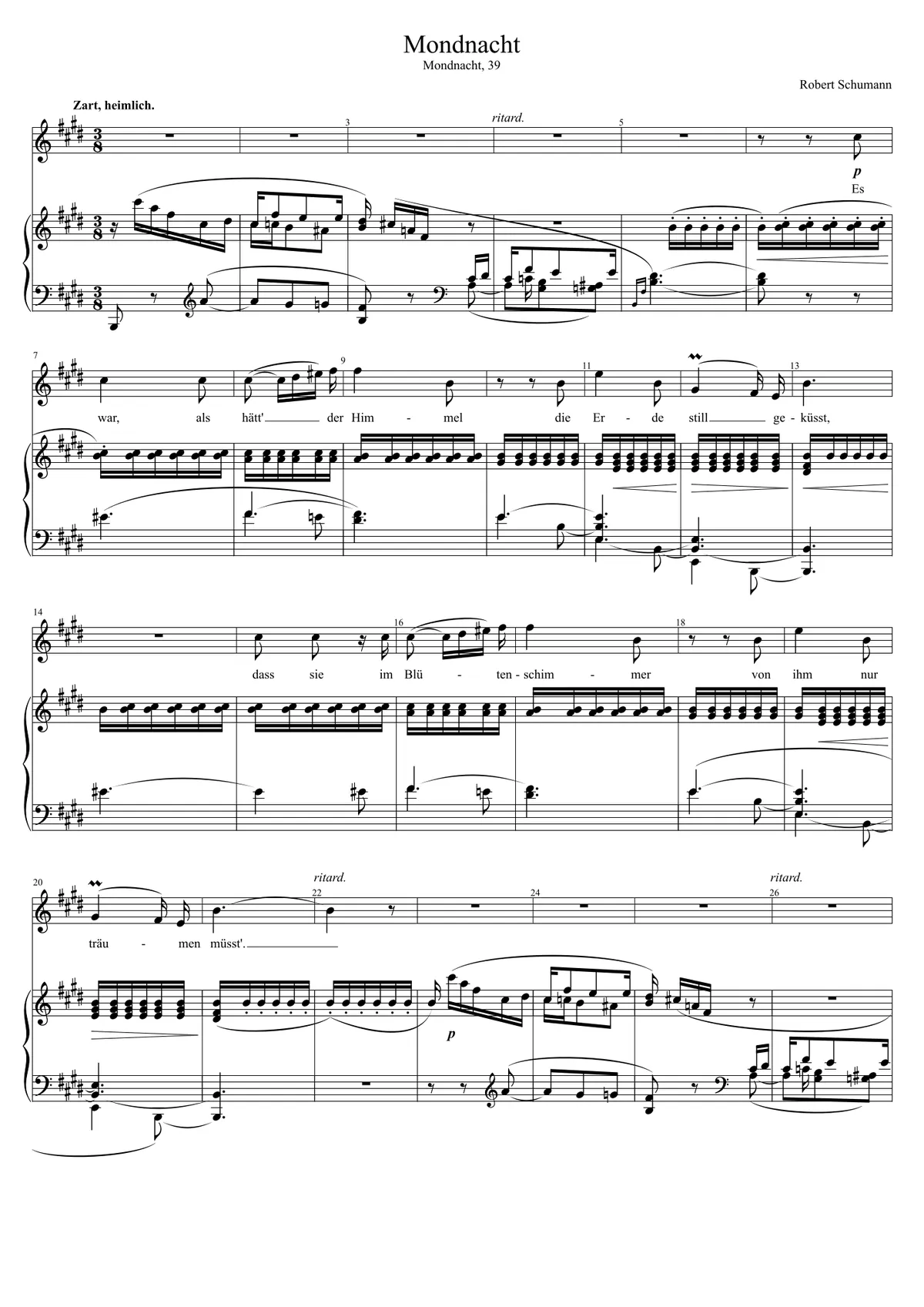
Schumann's Mondnacht, Op. 39 No. 5, to Eichendorff: a quiet E major Lied in 3/8. Phrasing and diction notes for piano accompaniment practice.
About the song
Mondnacht is the fifth song of Robert Schumann's Liederkreis, Op. 39, the twelve-song set to poems by Joseph von Eichendorff that he composed in 1840. The poem begins "Es war, als hätt' der Himmel die Erde still geküsst": it was as if the sky had quietly kissed the earth, so that she now had to dream of him. The second stanza describes the breeze moving over fields and forests on a starlit night, and in the third the speaker's soul spreads its wings and flies over the silent land as if flying home.
Schumann keeps the piano shimmering high in the texture while the voice repeats almost the same rising melody for the first two stanzas, so the opening of the third feels like a release. This edition is in E major in 3/8 and spans E4 to F♯5 over 68 measures. Teachers assign it because it tests the hardest skill in Lieder singing: staying soft, still and connected for a long time.
What to practice
Most of the song lives at a hushed dynamic, so practice sustaining pianissimo with full breath support rather than a thin, held tone. The slow 3/8 means long notes cover many piano pulses; count them precisely and avoid swelling on every sustained pitch. Keep the repeated melody of stanzas one and two from sounding identical by shaping the text differently each time.
In the final stanza, let the line open on spannte weit ihre Flügel aus without pushing the tempo, then return to stillness for the last phrase. Watch the German umlauts in hätt', geküsst and Blütenschimmer, and keep consonants crisp but light so they do not break the legato. Rehearse the piano postlude as part of the song, holding the mood until the last chord fades.
Who it suits
This edition suits a lyric high or medium voice with good breath control, and it is a strong choice for an intermediate undergraduate or a graduate recital group of Schumann songs.
Practicing it in Opusis
- Play the piano part on its own and sing over it: choose the voice part and switch to accompaniment practice, and the vocal line drops out.
- Move the song up or down by as much as an octave. The score is redrawn in the new key and the playback follows it.
- Set your own tempo and loop any passage until it sits.
Questions
- What does Mondnacht mean in English?
- Mondnacht means Moonlit Night. Eichendorff's poem describes a still night in which heaven and earth seem joined and the soul feels it is flying home.
- Which cycle is Mondnacht from?
- It is No. 5 of Schumann's Liederkreis, Op. 39, a set of twelve Eichendorff songs from 1840. It is often performed on its own as well as within the full cycle.
- Is Mondnacht hard to sing?
- The notes are not difficult and the range here is only E4 to F♯5, but the long, soft phrases and slow tempo demand excellent breath control and steadiness.
More songs
- In der FremdeRobert Schumann
- IntermezzoRobert Schumann
- WaldesgesprächRobert Schumann
- WidmungRobert Schumann
- Der NussbaumRobert Schumann
- Du bist wie eine BlumeRobert Schumann