Intermezzo (Robert Schumann) — practice with piano accompaniment
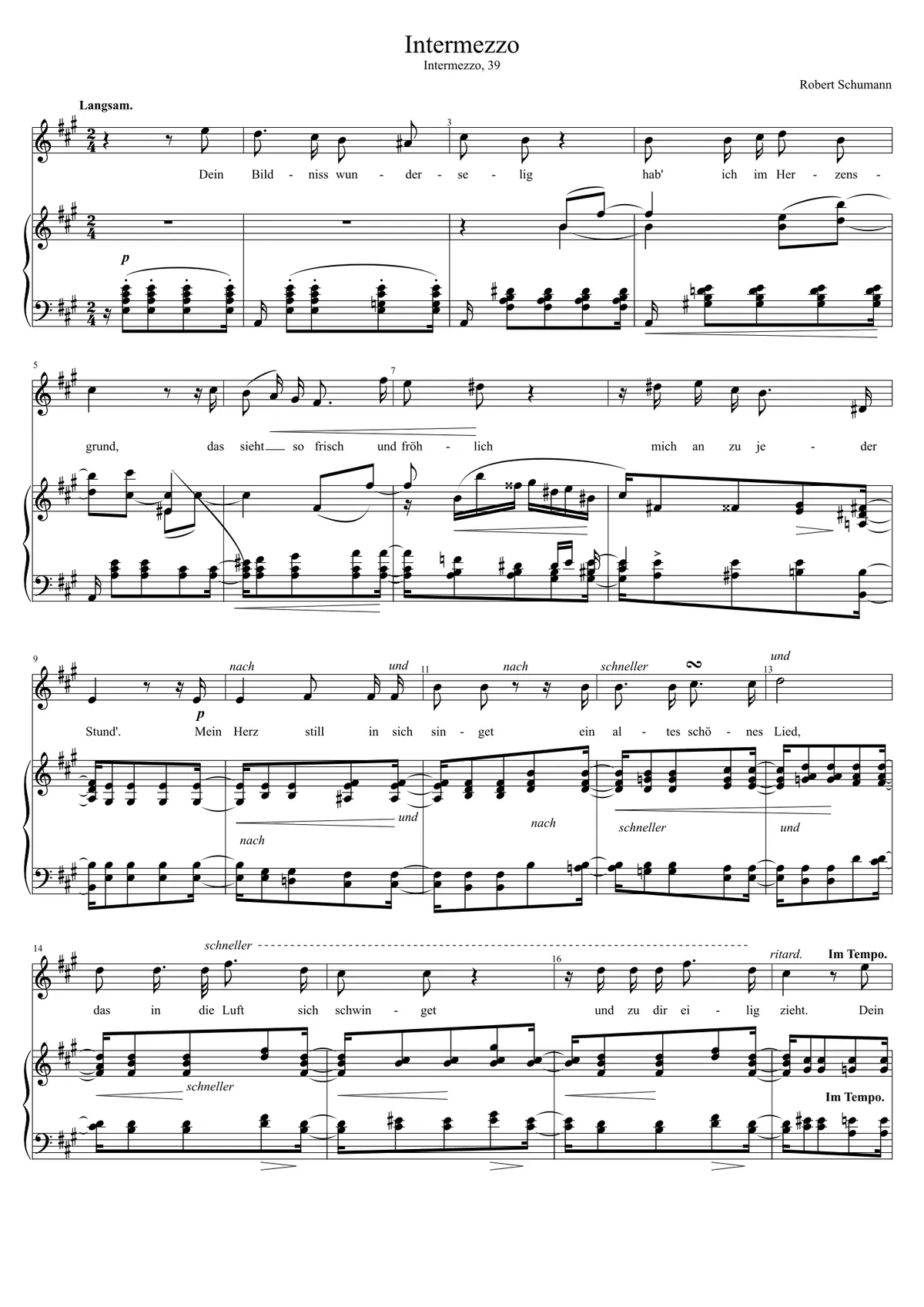
Schumann Intermezzo, Op. 39 No. 2 (Dein Bildnis wunderselig), Eichendorff: practice notes and piano accompaniment practice in A major.
About the song
Intermezzo is the second song of Robert Schumann’s Liederkreis, Op. 39, on poems by Joseph von Eichendorff. It begins “Dein Bildnis wunderselig hab’ ich im Herzensgrund”: deep in my heart I keep your wondrous image, and it looks at me so fresh and happy at every hour. In the middle stanza the heart quietly sings an old, lovely song to itself, and the song rises into the air and hurries to the beloved.
After the solemn opening song of the cycle, this is a brief burst of warmth. Schumann sets it in A major, marked Langsam, over pulsing off-beat chords in the piano that give the song a breathless, heart-beating feel. The middle stanza gradually speeds up, nach und nach schneller, before the first stanza returns Im Tempo. At 30 bars it is short, and a favorite to pair with In der Fremde or to program from the cycle on its own.
What to practice
The off-beat chords are the main ensemble issue. The voice tends to land with the piano’s syncopations and lose the downbeat, so first practice speaking the text in rhythm against the accompaniment, then sing it. F♯5 appears often, on phrases like “frisch und fröhlich,” so the tessitura sits higher than the range suggests; keep it bright and unpressured.
In the middle stanza, let the accelerando grow from “Mein Herz still in sich singet” to “und zu dir eilig zieht,” then take time with the ritard before the return. The reprise should sound like the same image seen again, quieter and more intimate. Decide how you will pronounce the -ig endings of “wunderselig” and “eilig,” most singers use the ich-Laut, and keep them consistent.
Who it suits
With a D♯4–F♯5 range and a fairly high tessitura in this edition, it suits soprano and tenor, and works well for undergraduate juries or as part of a Liederkreis group.
Practicing it in Opusis
- Play the piano part on its own and sing over it: choose the voice part and switch to accompaniment practice, and the vocal line drops out.
- Move the song up or down by as much as an octave. The score is redrawn in the new key and the playback follows it.
- Set your own tempo and loop any passage until it sits.
Questions
- What are the first words of Schumann’s Intermezzo, Op. 39?
- It begins “Dein Bildnis wunderselig,” your wondrous image, and it is sometimes listed under that first line instead of the title Intermezzo.
- Why is it called Intermezzo?
- The title marks it as a brief interlude: in the cycle it is a short moment of warmth between the brooding In der Fremde and Waldesgespräch.
More songs
- In der FremdeRobert Schumann
- MondnachtRobert Schumann
- WaldesgesprächRobert Schumann
- WidmungRobert Schumann
- Der NussbaumRobert Schumann
- Du bist wie eine BlumeRobert Schumann