Der Nussbaum (Robert Schumann) — practice with piano accompaniment
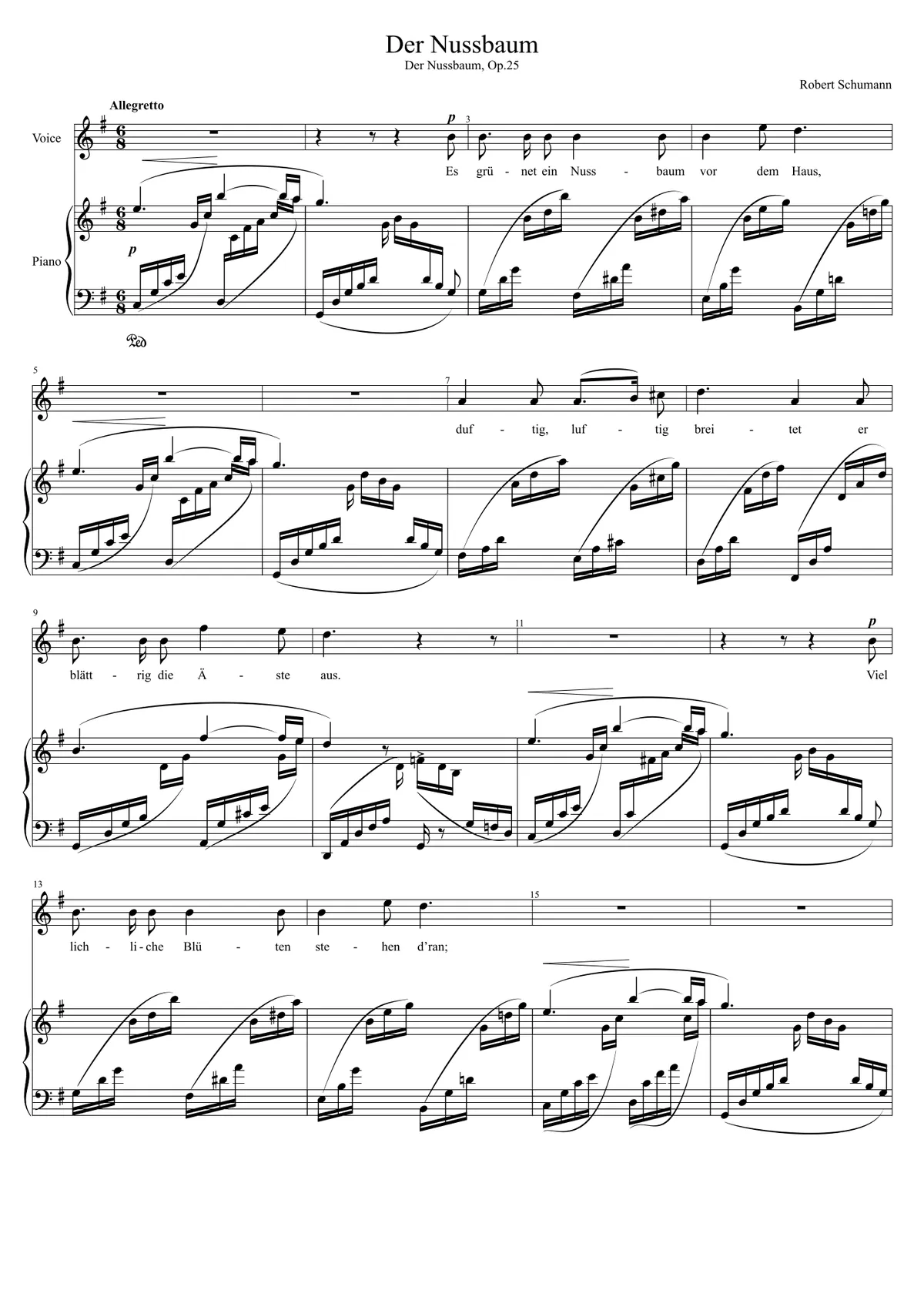
Schumann’s Der Nussbaum, Op.25 No.3 from Myrthen: Mosen text, G major, 6/8, voice D4–F♯5. A guide for piano accompaniment practice.
About the song
Der Nussbaum (The Walnut Tree) is the third song of Myrthen, Op. 25, the collection of 26 songs Robert Schumann assembled in 1840 as a wedding gift for Clara Wieck. Julius Mosen’s poem begins “Es grünet ein Nussbaum vor dem Haus, duftig, luftig” — a walnut tree grows green and fragrant in front of the house — and imagines its blossoms whispering to a young girl about a bridegroom who will come next year. She listens, smiles, and sinks into sleep and dreams.
Schumann sets it in G major and 6/8 over a rippling broken-chord accompaniment that hardly ever stops. What makes the song special is how the melody passes between the two performers: the piano introduces the opening motive and completes many of the phrases the voice leaves hanging. The result is less a tune with accompaniment than one line shared by two musicians, and teachers assign it as much for listening as for singing.
What to practice
The voice enters and drops out constantly, so rehearse the handoffs: know exactly where the piano takes the melody back, and keep your last note soft enough to let it. Many phrases end on an open, unfinished harmony; do not close them with a heavy release. Feel the 6/8 in two broad beats rather than six, or the rustling leaves turn into a lullaby too early.
The whispered lines of the blossoms need clear German consonants at a quiet dynamic, which is harder than it sounds. Save calm and breath for the last page, where the girl drifts off and the texture grows quieter; the piano has the final word, so stay in character until it finishes.
Who it suits
With a range of D4–F♯5 in this edition, it sits comfortably for lyric sopranos, mezzo-sopranos and tenors, and is a common choice for a first Schumann song or an early undergraduate jury.
Practicing it in Opusis
- Play the piano part on its own and sing over it: choose the voice part and switch to accompaniment practice, and the vocal line drops out.
- Move the song up or down by as much as an octave. The score is redrawn in the new key and the playback follows it.
- Set your own tempo and loop any passage until it sits.
Questions
- What is the poem of Der Nussbaum about?
- A walnut tree in blossom whispers to a girl about a bridegroom who will come next year; she listens and falls asleep smiling. It is a quiet, dreamy picture of youthful longing.
- Which collection is Der Nussbaum from?
- It is No. 3 of Myrthen, Op. 25, Schumann’s 1840 wedding gift to Clara. The set draws on many poets, including Goethe, Rückert, Heine, Byron and Burns.
- Is the piano part of Der Nussbaum difficult?
- The broken-chord figure runs almost throughout and must stay light and even, so it takes real practice; balance matters more than speed. The singer has to fit each phrase precisely into that moving texture.
More songs
- WidmungRobert Schumann
- Du bist wie eine BlumeRobert Schumann
- Die LotosblumeRobert Schumann
- In der FremdeRobert Schumann
- MondnachtRobert Schumann
- IntermezzoRobert Schumann