Die Lotosblume (Robert Schumann) — practice with piano accompaniment
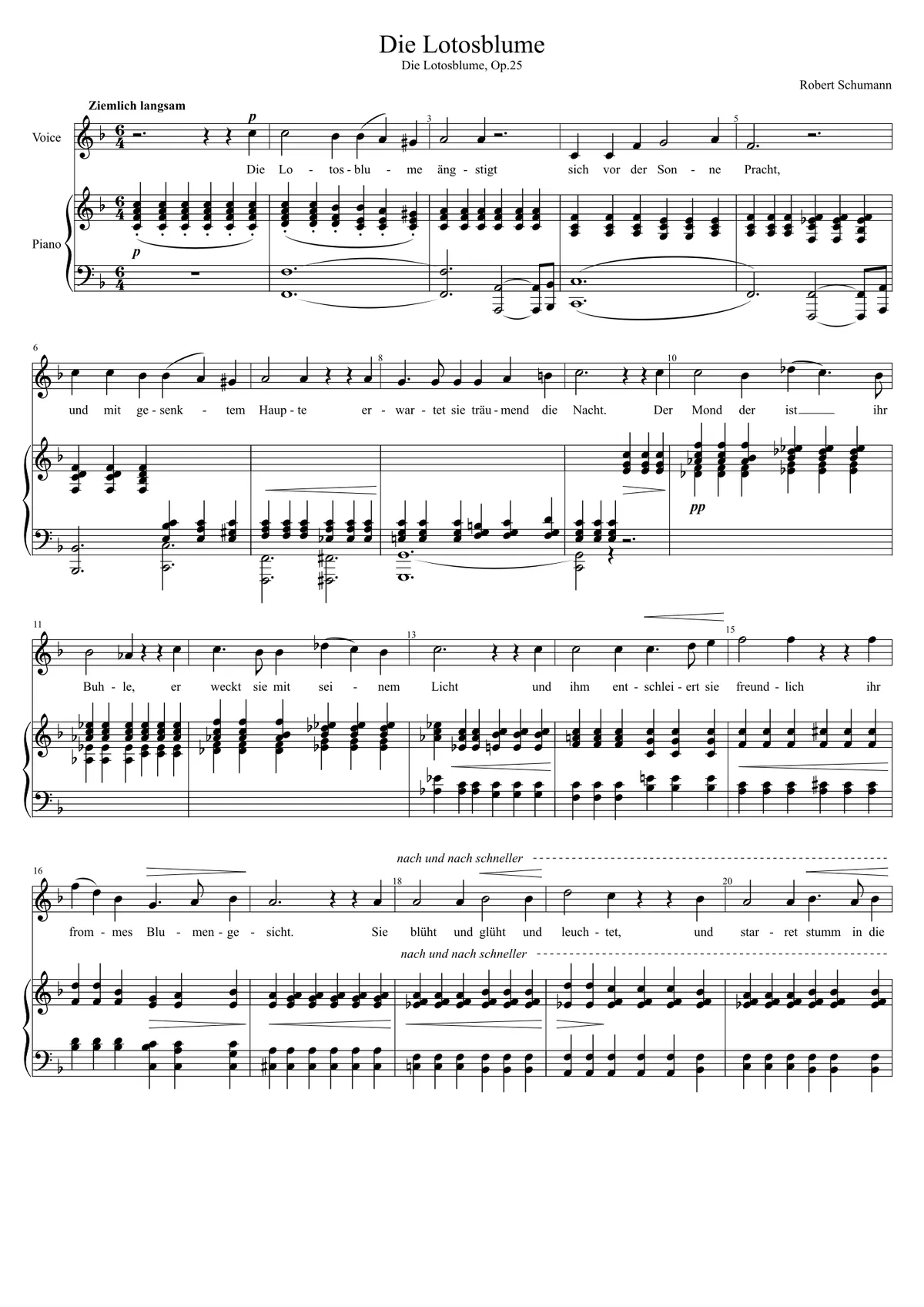
Schumann Die Lotosblume, Op. 25 No. 7, from Myrthen: Heine text, phrasing and pacing notes, and piano accompaniment practice in F major.
About the song
Die Lotosblume is No. 7 of Myrthen, Op. 25, the collection of 26 songs Robert Schumann gave Clara Wieck for their wedding in 1840. Heinrich Heine’s poem begins “Die Lotosblume ängstigt sich vor der Sonne Pracht”: the lotus flower is afraid of the sun’s splendor and waits, head bowed, dreaming of night. The moon is her lover; he wakes her with his light, and she unveils her gentle face to him. She blooms, glows and gazes silently upward, giving off fragrance, weeping and trembling with love and the pain of love.
Schumann sets it in F major, marked Ziemlich langsam, over steady repeated chords in 6/4. The surface is calm, but the last stanza gradually quickens, nach und nach schneller, toward the high point. Only 27 bars long, it is one of the most programmed songs in Myrthen.
What to practice
The 6/4 should feel like two broad beats, not six; let the piano’s even chords carry the pulse while the voice spins long phrases above them. Keep the first two stanzas quiet and unhurried, and save the color change for “Der Mond, der ist ihr Buhle.”
The final stanza is where the song lives. From “Sie blüht und glüht und leuchtet” the tempo presses forward little by little, reaching G5 on “zittert” before the ritard. Practice the accelerando with the pianist so it grows rather than lurches. Then settle into the piano close of “vor Liebe und Liebesweh,” which Schumann repeats. Watch the umlauts in “ängstigt,” “blüht” and “glüht,” and the clean final t in “Nacht” and “Licht.”
Who it suits
The C4–G5 range in this edition suits soprano or tenor, and it is a common first Schumann song for undergraduates; lower voices often sing it from a low-key edition.
Practicing it in Opusis
- Play the piano part on its own and sing over it: choose the voice part and switch to accompaniment practice, and the vocal line drops out.
- Move the song up or down by as much as an octave. The score is redrawn in the new key and the playback follows it.
- Set your own tempo and loop any passage until it sits.
Questions
- What collection is Die Lotosblume from?
- It is No. 7 of Schumann’s Myrthen, Op. 25, a set of 26 songs on poems by several authors that he gave Clara as a wedding gift in 1840.
- What is Die Lotosblume about?
- A lotus flower shies from the sun and opens only at night for her lover, the moon, trembling with love and love’s pain.
More songs
- WidmungRobert Schumann
- Der NussbaumRobert Schumann
- Du bist wie eine BlumeRobert Schumann
- In der FremdeRobert Schumann
- MondnachtRobert Schumann
- IntermezzoRobert Schumann