Wiegenlied (Johannes Brahms) — practice with piano accompaniment
Brahms's Wiegenlied, Op. 49 No. 4, the famous lullaby in E♭ major. German text, phrasing and tone tips for piano accompaniment practice.
About the song
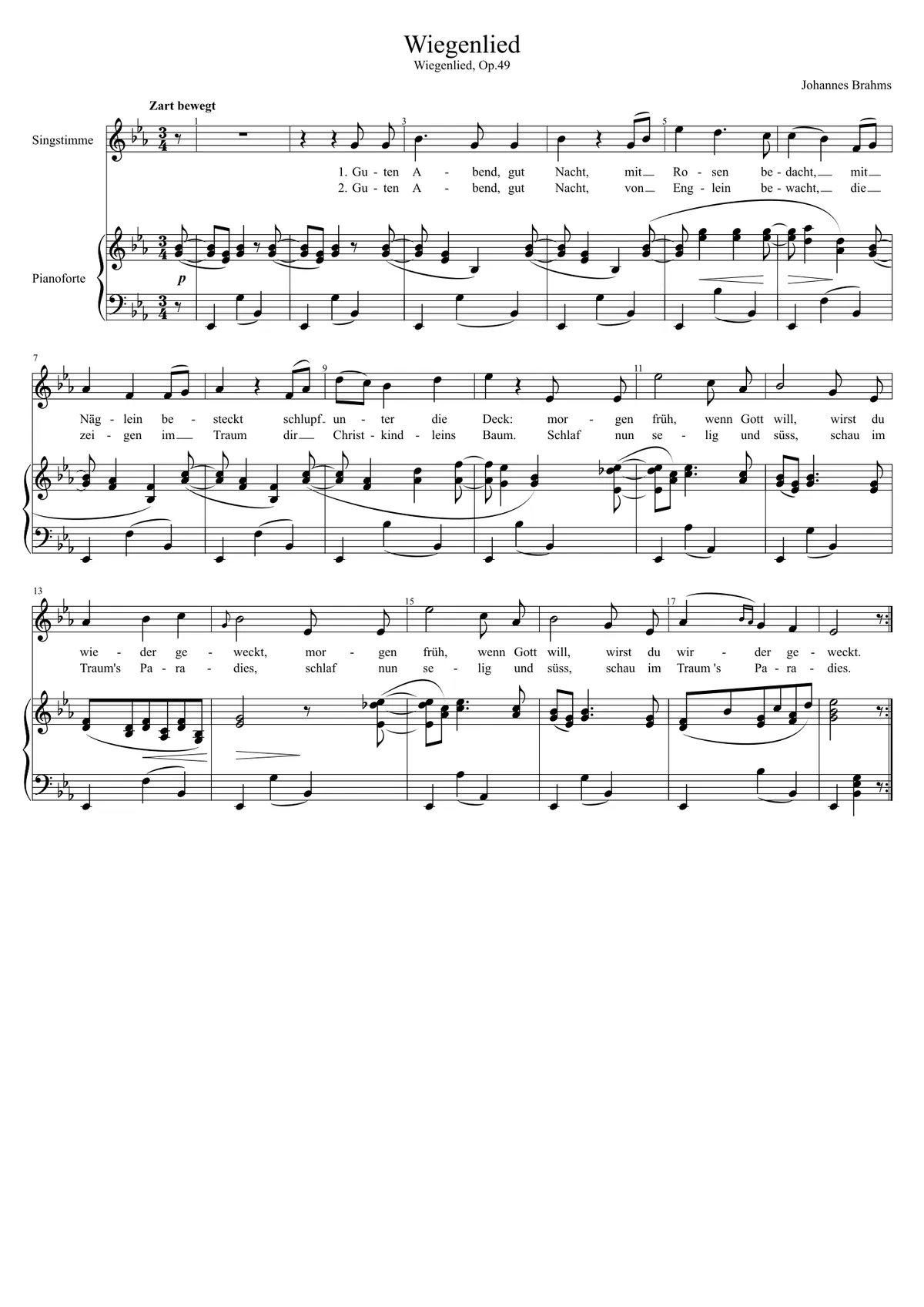
Brahms's Wiegenlied, Op. 49 No. 4, is probably the most familiar lullaby in the Western world. He wrote it in 1868 for his friend Bertha Faber on the birth of her son. The first stanza is a folk text from the collection Des Knaben Wunderhorn, beginning "Guten Abend, gut' Nacht, mit Rosen bedacht, mit Näglein besteckt": good evening, good night, covered with roses and decked with carnations, slip under the covers. The second stanza, added by Georg Scherer, promises that angels will show the child the Christmas tree in its dreams.
The song is strophic, with both stanzas sung to the same music. This edition is in E♭ major in 3/4, about 19 measures, and the voice spans one octave, E♭4 to E♭5. The piano gently rocks with offbeat figures under the vocal line, giving the tune its characteristic sway.
What to practice
Simplicity is harder than it looks. Keep the tone light and the line smooth, and resist the urge to linger at every phrase end. The piano's offbeat rhythm can tempt you to sing in short pulses; instead, phrase in long arcs across the bars while the accompaniment keeps the rocking motion.
Learn the German carefully, especially Näglein, schlupf unter die Deck' and Christkindleins Baum in the second stanza. Make the two stanzas different in color so the repetition sounds intentional, and finish the last phrase softly but with enough support that the pitch stays centered.
Who it suits
Its one-octave range in this edition makes it a good first German song for any beginning voice, including high school students and children's voices, and it also works as an encore for experienced singers.
Practicing it in Opusis
- Play the piano part on its own and sing over it: choose the voice part and switch to accompaniment practice, and the vocal line drops out.
- Move the song up or down by as much as an octave. The score is redrawn in the new key and the playback follows it.
- Set your own tempo and loop any passage until it sits.
Questions
- What are the words to Brahms's Lullaby in German?
- It begins Guten Abend, gut' Nacht, mit Rosen bedacht, mit Näglein besteckt. The first stanza comes from Des Knaben Wunderhorn and the second is by Georg Scherer.
- Why did Brahms write the Wiegenlied?
- Brahms wrote it in 1868 as a gift for his friend Bertha Faber after the birth of her son, and published it as No. 4 of his Op. 49.