Von ewiger Liebe (Johannes Brahms) — practice with piano accompaniment
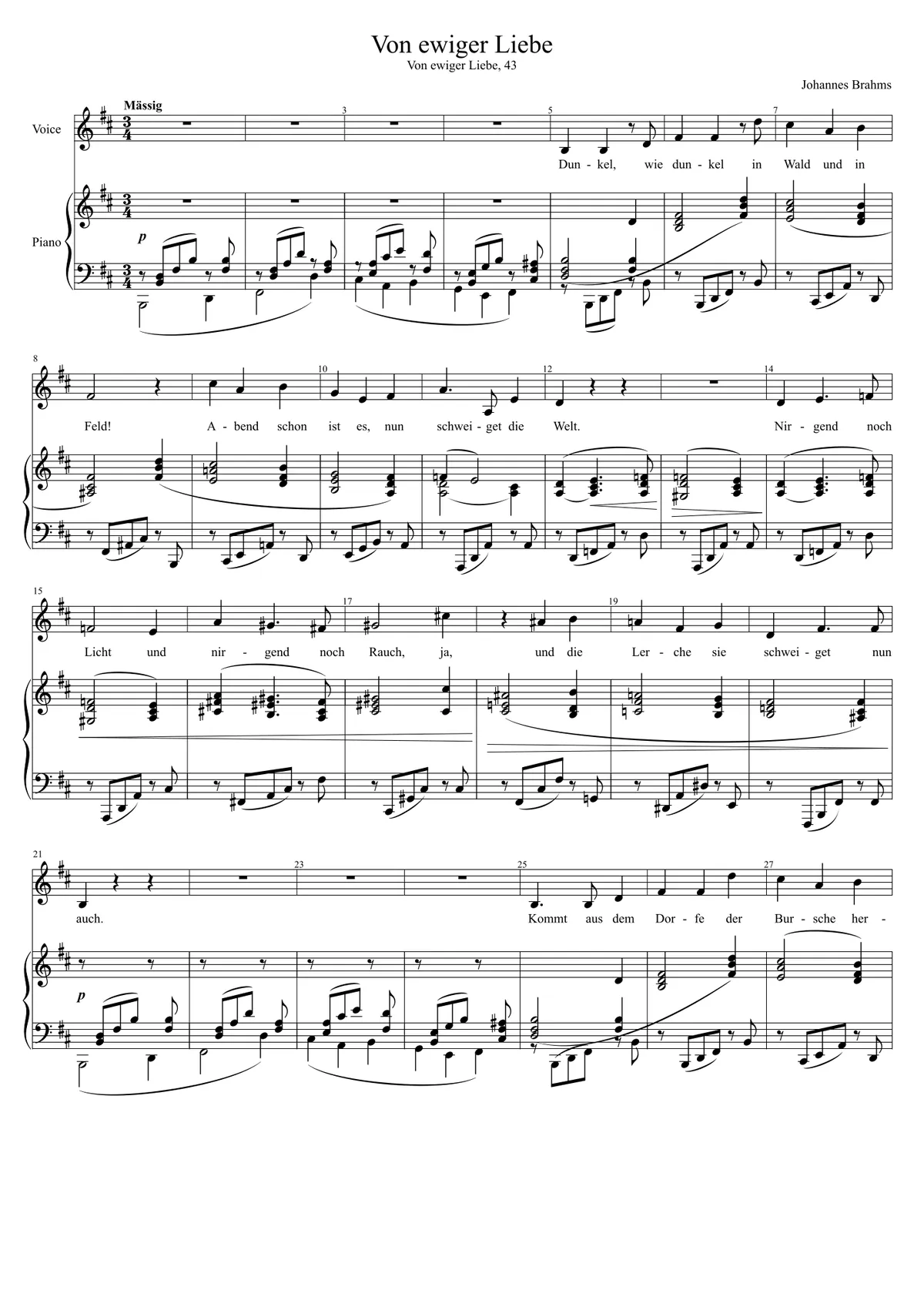
Brahms’s Von ewiger Liebe, Op.43 No.1: Wenzig text, B minor to B major, voice A3–F♯5, 121 bars. Piano accompaniment practice notes.
About the song
Von ewiger Liebe (Of Eternal Love) is the first of Brahms’s Four Songs, Op. 43, and one of his largest and most dramatic Lieder. Josef Wenzig’s text, adapted from a Wendish (Sorbian) folk poem, is a small drama with a narrator and two speakers. It begins “Dunkel, wie dunkel in Wald und in Feld! Abend schon ist es” — dark, how dark in wood and field, evening has already come — as a young man walks his sweetheart home. He tells her that if she suffers shame because of him, their love should end as quickly as it began. She answers that iron and steel can be reforged, but no one can change their love; it must last forever.
Brahms gives each speaker distinct music: dark, restless B minor and surging piano writing for the narrator and the youth, and a broad turn to B major for the girl’s reply, which builds to a powerful close. Across 121 measures it demands stamina and a wide dynamic range, and it is a staple of mezzo and soprano recitals.
What to practice
Treat the song as three characters. The narrator’s opening sits low, reaching down to A3, and should be quiet and atmospheric; the youth’s lines are agitated and need forward drive; the girl’s answer needs warmth and a long, broadening line. Pace your energy, because the climax comes at the very end, and singers who spend everything on the youth have little left for it. The piano part is thick, so work on carrying through it with focused tone rather than force. Keep the German crisp in the faster passages, especially the repeated lines about iron and steel, and let the move to major feel like a new world, not just a louder one.
Who it suits
With a range of A3–F♯5 in this edition, it suits mezzo-sopranos and full lyric or dramatic sopranos with a strong lower middle; it is best for advanced undergraduates and graduate singers.
Practicing it in Opusis
- Play the piano part on its own and sing over it: choose the voice part and switch to accompaniment practice, and the vocal line drops out.
- Move the song up or down by as much as an octave. The score is redrawn in the new key and the playback follows it.
- Set your own tempo and loop any passage until it sits.
Questions
- What is Von ewiger Liebe about?
- A young man walking his beloved home offers to part if their love brings her shame. She refuses: iron and steel can be reforged, she says, but their love will last forever.
- Who are the speakers in Von ewiger Liebe?
- There are three: a narrator who sets the evening scene, the young man, and the girl. One singer voices all of them, and Brahms gives the girl her own music in the major.
- Is Von ewiger Liebe too heavy for a young singer?
- It is long and needs stamina and a full sound over a dense piano part, so most teachers assign it once a singer has secure breath support and a reliable lower range.