An die Nachtigall (Johannes Brahms) — practice with piano accompaniment
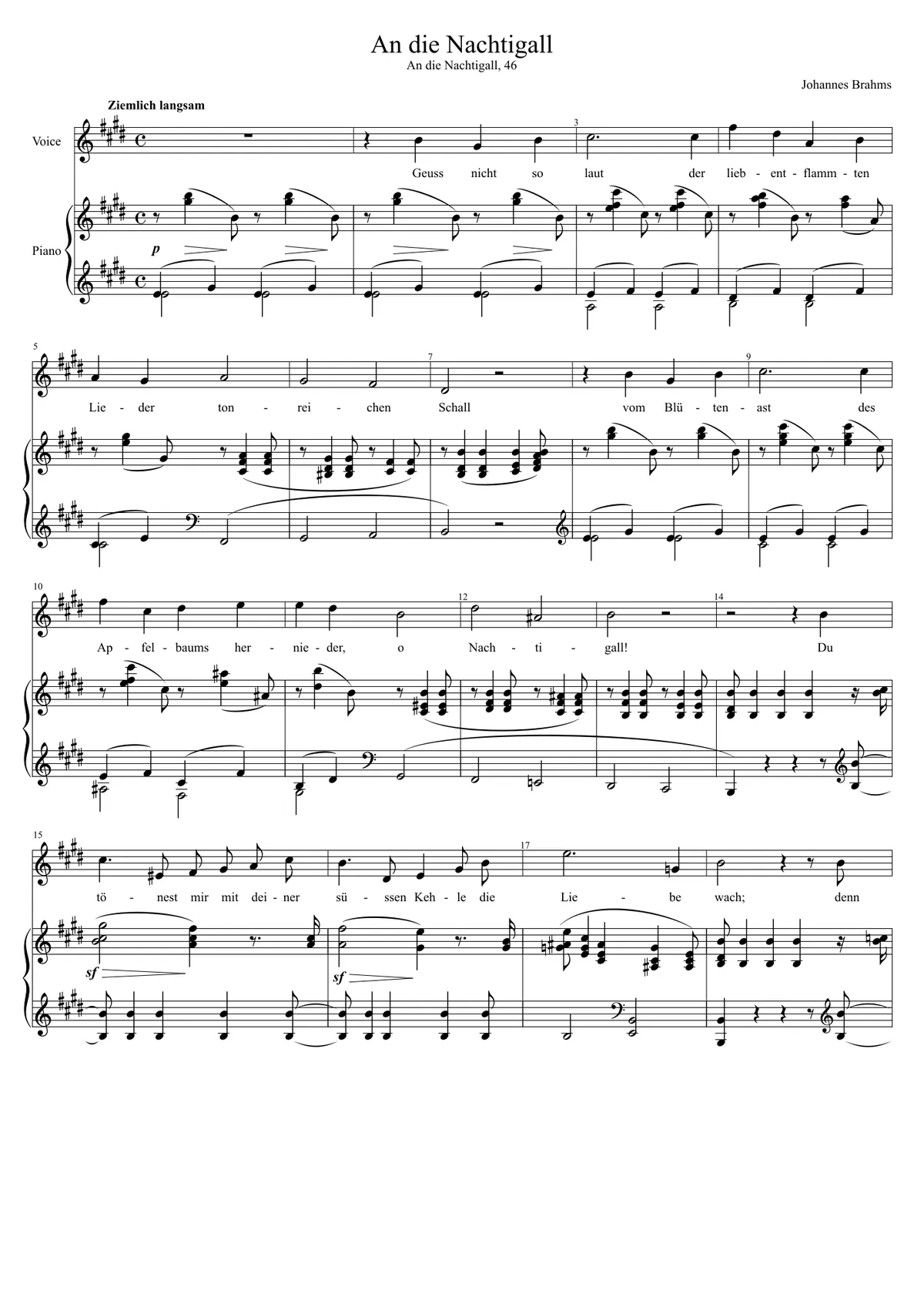
Brahms’s An die Nachtigall, Op. 46 No. 4, with piano accompaniment: Hölty’s plea to a nightingale in E major, 4/4, voice D♯4–G5.
About the song
Ludwig Hölty’s poem pleads with a nightingale: “Geuss nicht so laut der liebentflammten Lieder tonreichen Schall” — do not pour out so loudly the full sound of your love-kindled songs — from the blossoming branch of the apple tree. The bird’s song wakes a longing that drives off sleep and leaves the speaker staring at the sky, pale and tearful, and the poem ends by sending the bird away into the dark grove, to its mate.
Brahms composed his setting in 1868; it is the fourth and last of the songs of Op. 46. Schubert had set the same poem decades earlier, but Brahms’s version is broader and darker, with a long-breathed melody over a rich piano part and harmony that clouds over as the speaker describes sleepless nights. It shows Brahms’s vocal writing at its warmest in a compact 57 measures.
What to practice
Brahms asks for long phrases at a moderate tempo, so plan breaths where the text allows and keep to them; snatched breaths break the arch of the melody. The line climbs to G5 and also dips low, so work the passage through the middle voice until the color stays even across the range.
Hölty’s German is old-fashioned and consonant-heavy (Geuss, liebentflammten, tonreichen); keep the consonants quick so the vowels carry the legato. The emotional turn in the middle of the poem calls for a darker, more inward sound, then a release in the last lines as the bird is sent away. Brahms’s piano writing is full, so agree with your pianist on balance at the climaxes.
Who it suits
In this edition (D♯4–G5) it suits high voices, especially lyric sopranos and tenors, and makes a strong first Brahms song for upper-level undergraduates; medium voices usually sing it in a lower key.
Practicing it in Opusis
- Play the piano part on its own and sing over it: choose the voice part and switch to accompaniment practice, and the vocal line drops out.
- Move the song up or down by as much as an octave. The score is redrawn in the new key and the playback follows it.
- Set your own tempo and loop any passage until it sits.
Questions
- What does An die Nachtigall mean?
- To the Nightingale. The speaker asks the bird to sing less loudly, because its song stirs a love-longing that keeps him awake.
- Did Schubert also set An die Nachtigall?
- Yes, Schubert set the same Hölty poem. Brahms’s setting is Op. 46 No. 4, composed in 1868, and is longer and more harmonically intense.