Die Mainacht (Johannes Brahms) — practice with piano accompaniment
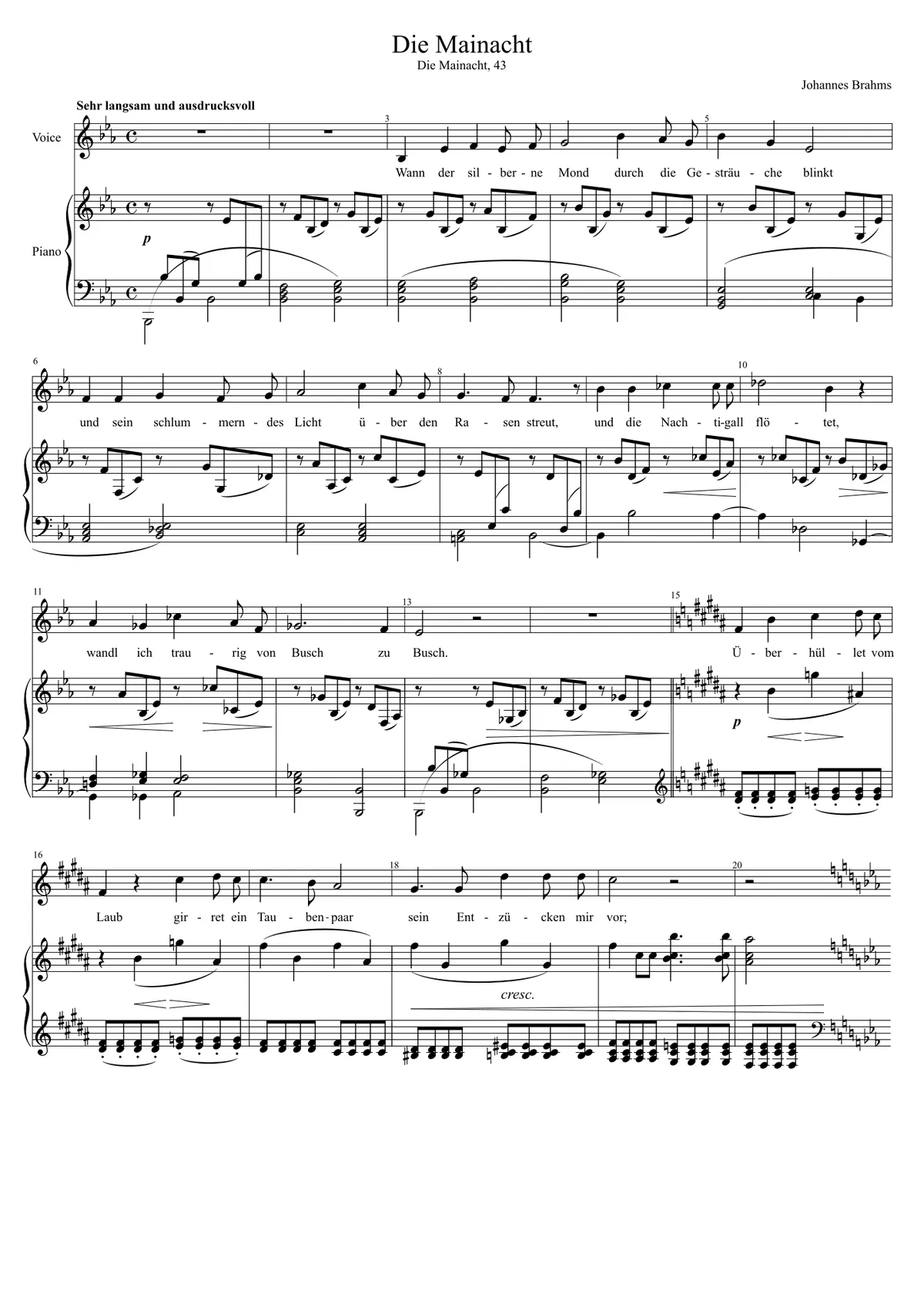
Brahms's Die Mainacht, Op. 43 No. 2, to Hölty, in E♭ major for low voice: breath, line and key-change notes for piano accompaniment practice.
About the song
Die Mainacht is the second of Brahms's Four Songs, Op. 43, and one of his most admired Lieder. The text is by Ludwig Christoph Heinrich Hölty. It opens "Wann der silberne Mond durch die Gesträuche blinkt": when the silver moon gleams through the bushes and the nightingale sings, the speaker wanders sadly from bush to bush. Hearing a pair of doves cooing to each other, he turns away into darker shadows, and asks when the smiling image he longs for will appear; a lonely tear runs hot down his cheek.
Brahms shapes the poem in three sections. The opening melody is broad and slow, the middle section about the doves moves into a different key area, and the return of the opening material grows into the song's largest climax. This edition is in E♭ major and sits low, from B♭3 to F♭5, over 52 measures. Singers value it for its long phrases and its rich, dark color.
What to practice
Breath planning comes first. The phrases are long and the tempo is slow, so mark where the poetry allows a breath and practice reaching the ends of phrases with support left over. Keep the tone even through the lower notes near B♭3 without forcing chest weight.
Treat the key change as a shift in color: the middle section is more restless, and the accompaniment moves differently there, so rehearse the transitions with your pianist until the tempo holds. On the return, pace the crescendo toward the final lines carefully, so the last climb has somewhere to go. Sustain German vowels through consonant clusters such as Gesträuche and einsame, and keep the line connected when the piano texture thickens.
Who it suits
In this low edition it suits mezzo-soprano, contralto, baritone or bass, and it is best for an advanced undergraduate or graduate singer with secure breath management.
Practicing it in Opusis
- Play the piano part on its own and sing over it: choose the voice part and switch to accompaniment practice, and the vocal line drops out.
- Move the song up or down by as much as an octave. The score is redrawn in the new key and the playback follows it.
- Set your own tempo and loop any passage until it sits.
Questions
- Who wrote the poem Die Mainacht?
- The poem is by Ludwig Christoph Heinrich Hölty, an eighteenth-century German poet. Brahms set it as the second song of his Op. 43.
- What voice type sings Die Mainacht?
- It is sung by many voice types in different keys. This edition, in E♭ major with a range of B♭3 to F♭5, fits lower voices such as mezzos and baritones.
- Does Die Mainacht change key?
- Yes. The middle section about the cooing doves moves away from E♭ major before the opening material returns for the final, intensified section.