Après un rêve (Gabriel Fauré) — practice with piano accompaniment
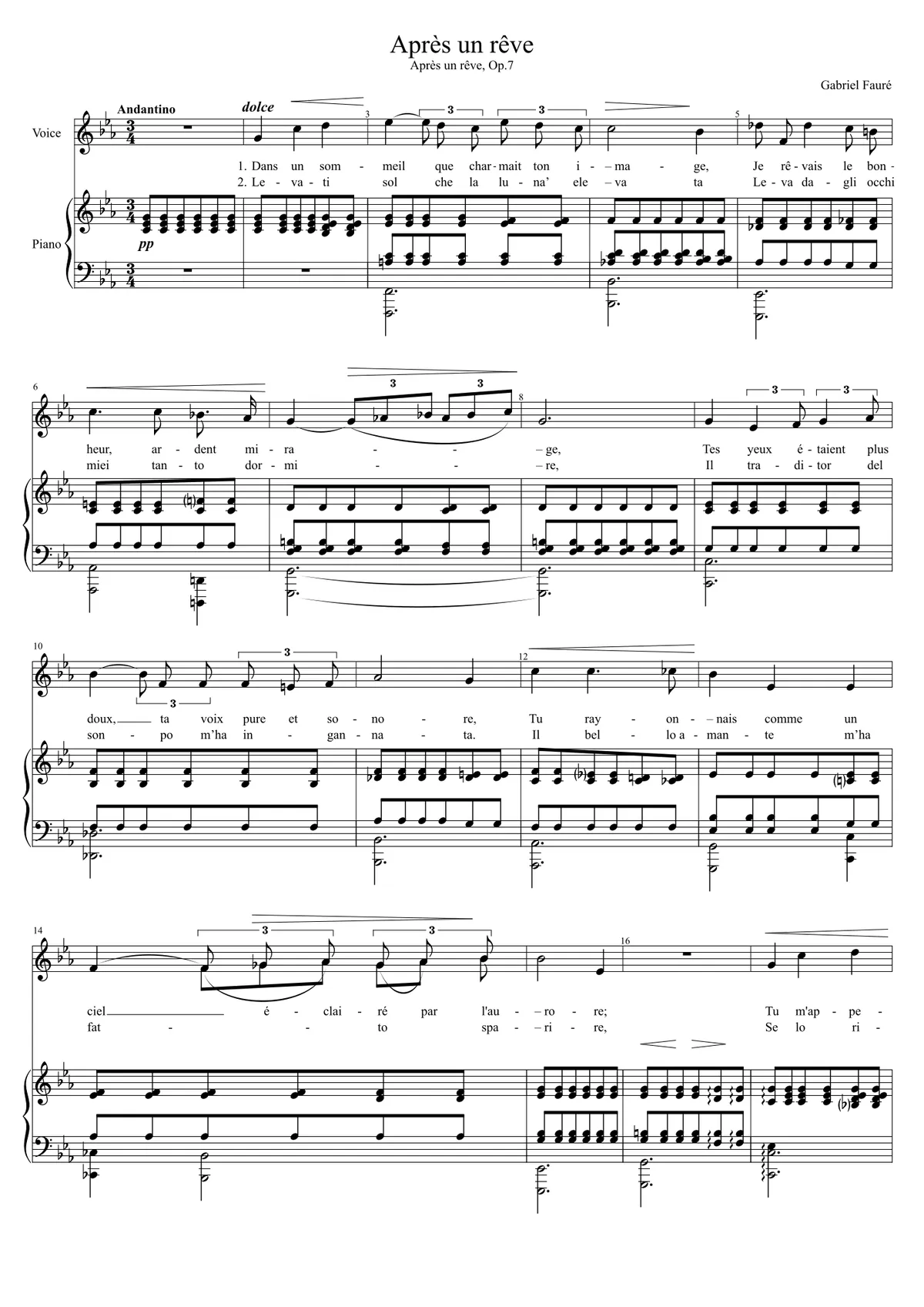
Fauré's Après un rêve, Op. 7 No. 1, in C minor for medium-high voice: text, phrasing and breath tips for piano accompaniment practice.
About the song
Après un rêve opens Fauré's Op. 7, a set of three songs that also includes Hymne and Barcarolle. The poem is by Romain Bussine, who adapted it from an anonymous Tuscan original. Its first line, "Dans un sommeil que charmait ton image," sets the scene: in a sleep enchanted by the beloved's image, the speaker dreams of fleeing with them toward a radiant light. Waking breaks the spell, and the final stanza pleads with the mysterious night to return and give back its illusions.
Fauré sets this in 3/4 over a steady pulse of repeated piano chords, letting the voice float a long, arching line above them. This edition is in C minor and spans C4 to F5, with the climax reserved for the cry of the waking dreamer. At 48 measures it is compact, but it asks for real legato and control. Singers program it because it shows line, French diction and emotional restraint all at once, and because audiences know the melody well.
What to practice
The main challenge is sustaining the long phrases without letting the tempo sag. Mark breaths with the poetry rather than wherever air runs out, and practice the opening stanza on a single vowel first to find an unbroken legato over the bar lines. The piano chords keep moving, so the voice can stretch slightly against them but should land back with the accompanist at phrase ends.
French diction needs care: keep the nasal vowels in songe and mensonges forward, avoid adding diphthongs, and let final schwas be short and unaccented. Save full voice for the outburst on hélas and the final reviens, and practice the soft ending so the last line stays supported at a low dynamic.
Who it suits
In this edition it fits a high-medium voice, such as a lyric soprano, mezzo or tenor, and works well as a first French mélodie for an undergraduate or an audition piece that shows legato.
Practicing it in Opusis
- Play the piano part on its own and sing over it: choose the voice part and switch to accompaniment practice, and the vocal line drops out.
- Move the song up or down by as much as an octave. The score is redrawn in the new key and the playback follows it.
- Set your own tempo and loop any passage until it sits.
Questions
- What does Après un rêve mean?
- The title means After a Dream. The poem describes a blissful dream of the beloved and the sadness of waking, ending with a plea for the night to return.
- Who wrote the text of Après un rêve?
- Romain Bussine wrote the French text, adapting an anonymous Italian poem from Tuscany. Fauré published it as the first of his three songs, Op. 7.
- What is the vocal range of Après un rêve in this edition?
- This edition is in C minor and the voice moves between C4 and F5, which sits comfortably for many sopranos, mezzos and tenors.