Adieu (Gabriel Fauré) — practice with piano accompaniment
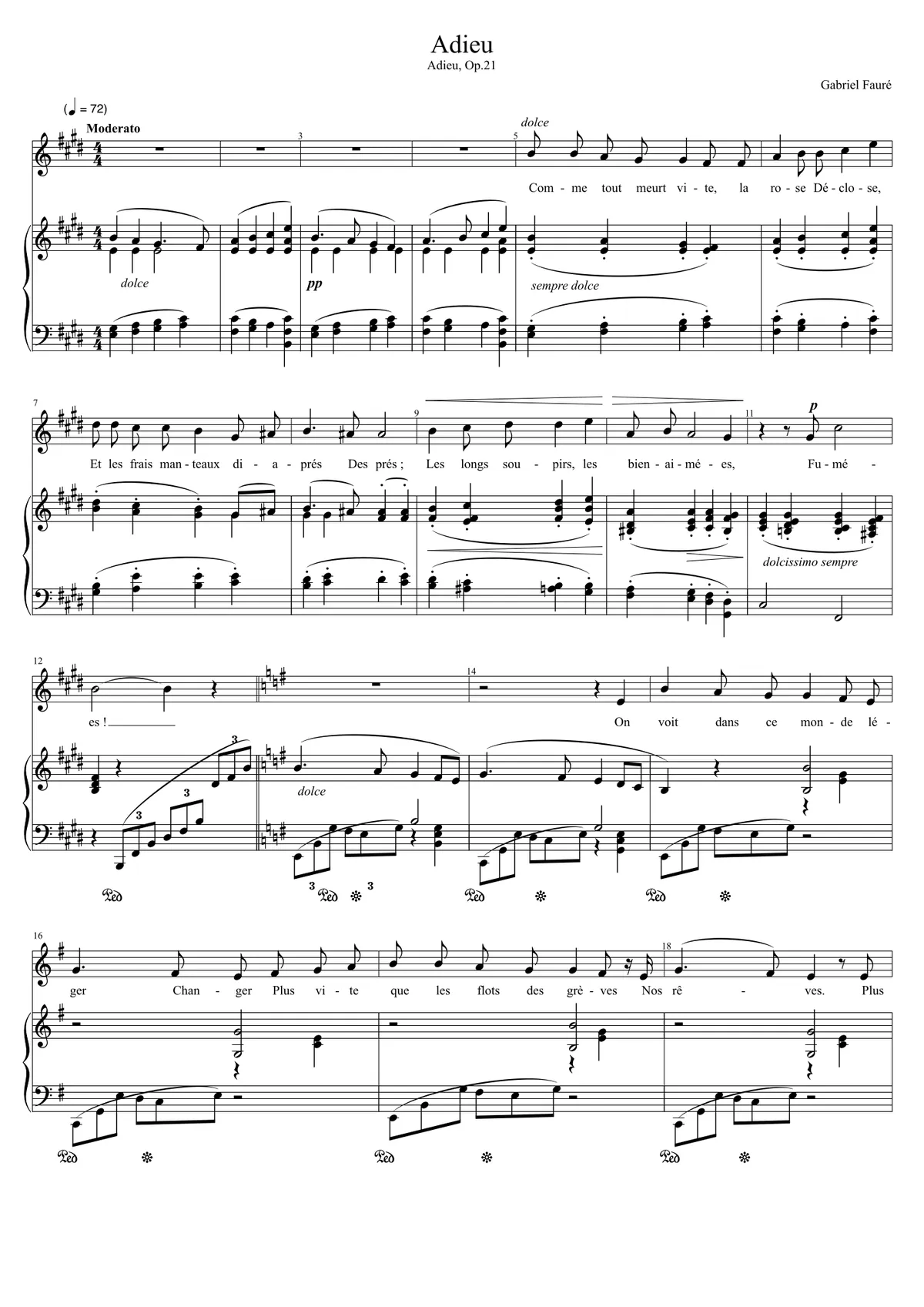
Fauré’s Adieu, Op.21 No.3, from Poème d’un jour: Grandmougin text, E major, one-octave range E4–E5. Notes for piano accompaniment practice.
About the song
Adieu is the last of the three songs in Fauré’s Poème d’un jour, Op. 21, a short sequence to poems by Charles Grandmougin that traces a love affair from first meeting (Rencontre) through passionate insistence (Toujours) to this quiet farewell. “Comme tout meurt vite, la rose déclose” — how quickly everything dies, the rose once it has opened — the poem begins, and it goes on to name other things that fade, from the bright colors of the meadows to lovers’ sighs, before the speaker says goodbye without bitterness.
Grandmougin uses echo rhymes, in which a short line repeats the sound of the one before (rose and déclose, diaprés and prés), and Fauré lets those little echoes fall naturally in a simple, flowing vocal line over a chordal accompaniment, written here in E major. The song is brief and restrained, and its weight comes from that restraint. It is often sung alone as an introduction to Fauré, but it gains even more at the end of the complete set.
What to practice
The voice stays within a single octave, E4 to E5, so this is a song about line and text rather than range. Sing the French on long, connected vowels and let the short echo-rhyme lines land lightly instead of accenting them. Keep the tempo moving; at a sluggish pace the phrases lose their shape and the farewell turns maudlin. Plan each phrase so you can taper its ending to a true piano.
The harmony moves away from E major and back again, so practice the vocal entries after those shifts until the pitch is secure, using the bass line as your anchor.
Who it suits
With its one-octave range in this edition, it suits young sopranos, mezzo-sopranos and tenors and is a strong first French mélodie for high school or early undergraduate students.
Practicing it in Opusis
- Play the piano part on its own and sing over it: choose the voice part and switch to accompaniment practice, and the vocal line drops out.
- Move the song up or down by as much as an octave. The score is redrawn in the new key and the playback follows it.
- Set your own tempo and loop any passage until it sits.
Questions
- What is Poème d’un jour?
- It is Fauré’s three-song set, Op. 21, to poems by Charles Grandmougin: Rencontre, Toujours and Adieu. Together they tell the story of a love affair within a single day, from meeting to parting.
- Is Fauré’s Adieu good for a beginner?
- Yes. Its compact range and moderate pace make it approachable, though it still asks for a polished legato and careful French.
- What does Comme tout meurt vite mean?
- It means “how quickly everything dies.” The opening line likens the end of love to a rose that fades soon after it opens.