Morgen! (Richard Strauss) — practice with piano accompaniment
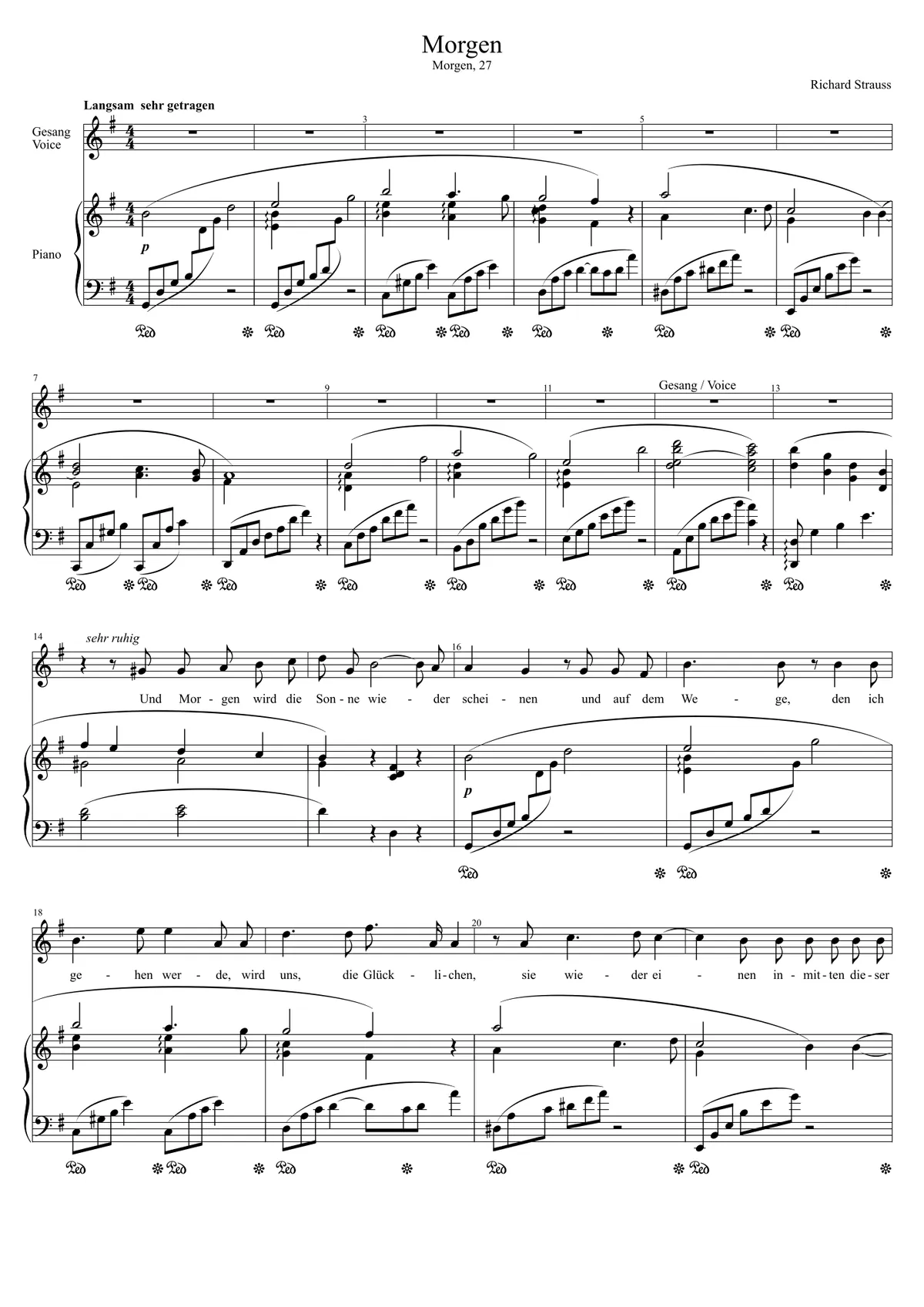
Strauss’s Morgen!, Op. 27 No. 4, with piano accompaniment: Mackay’s quiet poem of tomorrow’s happiness in G major, voice F♯4–G5.
About the song
Morgen! (Tomorrow!) is the last of the four songs of Richard Strauss’s Op. 27, set to a poem by John Henry Mackay. The text starts in the middle of a thought, “Und morgen wird die Sonne wieder scheinen” — and tomorrow the sun will shine again — and imagines two lovers walking down to a wide shore, looking into each other’s eyes as a mute silence of happiness settles over them.
Strauss lets the piano begin alone with a long, complete melody. When the voice enters, it does not take over the tune but speaks quietly above it, in long notes and gentle declamation, and the piano is left alone again at the end. The result is one of the most intimate songs in the repertoire: slow, spare, and suspended. Singers often place it last in a Strauss group, where its stillness can register after more extroverted songs.
What to practice
Everything depends on sustaining a soft, even line at a slow tempo. Count the introduction carefully and feel your entry as a continuation of the piano’s melody, not a new beginning. The vocal part has long values and repeated pitches; shape it with the natural stress of Mackay’s words rather than with a swell on every note.
The line sits in the upper middle of the staff, which can tire a voice singing quietly, so practice the phrases softly with full breath support rather than a held throat. German diction should be gentle but exact, especially the -en endings and the ü and ch of des Glückes stummes Schweigen. The silences matter as much as the notes: rehearse with the accompaniment until you can stay completely still through the piano’s phrases.
Who it suits
In this edition (F♯4–G5) it suits high voices, lyric sopranos and tenors in particular. The range is modest, but the control it demands makes it better suited to advanced undergraduates and graduate students than to beginners.
Practicing it in Opusis
- Play the piano part on its own and sing over it: choose the voice part and switch to accompaniment practice, and the vocal line drops out.
- Move the song up or down by as much as an octave. The score is redrawn in the new key and the playback follows it.
- Set your own tempo and loop any passage until it sits.
Questions
- What does Morgen mean, and who wrote the poem?
- Morgen means tomorrow. The poem is by John Henry Mackay, a Scottish-born poet who grew up in Germany and wrote in German.
- Why does the voice enter so late in Morgen!?
- Strauss gives the piano the whole melody first. The voice joins as if stepping into a song already in progress and floats its own quieter line above the tune.
- Is Morgen! difficult to sing?
- The notes are not hard, but the slow tempo, soft dynamics, and fairly high tessitura make heavy demands on breath control and steadiness of tone.