Come Away, Death (Roger Quilter) — practice with piano accompaniment
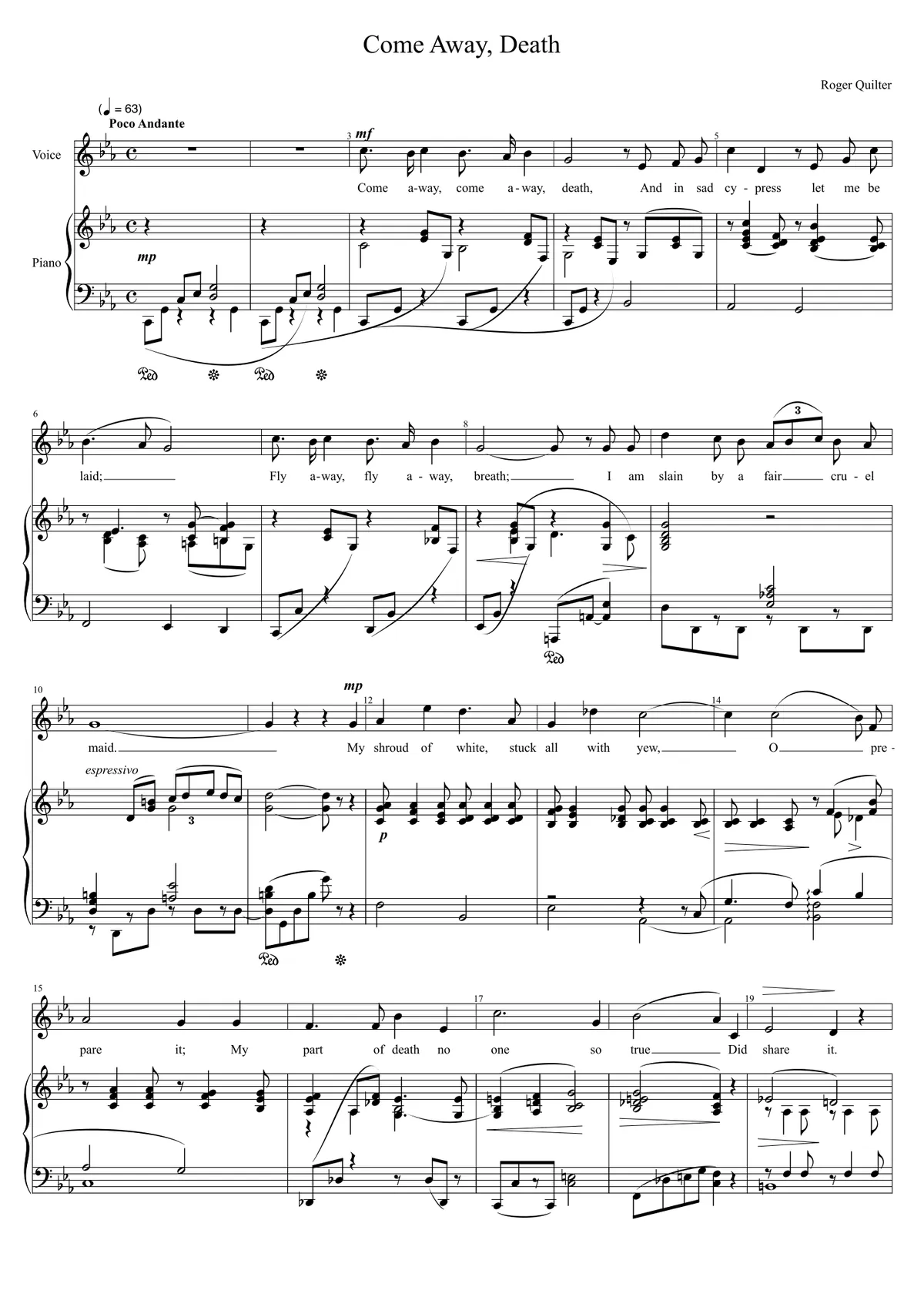
Quilter Come Away, Death, Op. 6 No. 1: Shakespeare text from Twelfth Night, phrasing notes, and piano accompaniment practice in C minor.
About the song
Come Away, Death is the first of Roger Quilter’s Three Shakespeare Songs, Op. 6, published by Boosey in 1905 alongside O Mistress Mine and Blow, Blow, Thou Winter Wind. The text is Feste’s song from Twelfth Night, “Come away, come away, death, and in sad cypress let me be laid”: a lover slain by a fair, cruel maid asks for death, a white shroud stuck with yew, and a grave where no true lover will ever find him to weep.
Quilter sets it in C minor, marked Poco Andante, with rich, slow-moving harmony and a vocal line that stays expressive and intimate. The second stanza moves on a little, a tempo e poco con moto, and builds to forte at “A thousand thousand sighs to save” before falling back for the close. It is a standard of English art song and a frequent choice for students building an English set.
What to practice
Plan the arc of the whole song. The first stanza lives between mp and p; the second grows from p through poco crescendo to the forte at “A thousand thousand sighs.” Do not peak too early, since E♭5 arrives first in “My shroud of white,” then again at “A thousand thousand sighs” and “to weep there.”
Sing the English as poetry, not speech. Shape the doubled phrases, “come away, come away” and “not a flower, not a flower sweet,” so the repeat intensifies, and keep the final consonants of “death,” “breath” and “laid” clean without clipping the line. Quilter writes espressivo freely; take the rubato with the pianist, because the harmony underneath moves expressively and needs room.
Who it suits
With a C4–E♭5 range in this edition, it suits medium and lower voices, mezzo-soprano, baritone or bass-baritone, and is a dependable English song for undergraduate auditions and first recitals.
Practicing it in Opusis
- Play the piano part on its own and sing over it: choose the voice part and switch to accompaniment practice, and the vocal line drops out.
- Move the song up or down by as much as an octave. The score is redrawn in the new key and the playback follows it.
- Set your own tempo and loop any passage until it sits.
Questions
- Which play is Come Away, Death from?
- Shakespeare’s Twelfth Night. The clown Feste sings it for Duke Orsino in Act II.
- What are Quilter’s Three Shakespeare Songs?
- Op. 6 contains Come Away, Death, O Mistress Mine, and Blow, Blow, Thou Winter Wind, often performed together as a set.
- Is Come Away, Death good for a low voice?
- In this edition the voice sits between C4 and E♭5, which is comfortable for most mezzos and baritones.