Blow, Blow, Thou Winter Wind (Roger Quilter) — practice with piano accompaniment
Quilter Blow, Blow, Thou Winter Wind, Op. 6 No. 3: Shakespeare text from As You Like It, refrain tips, and piano accompaniment practice in C minor.
About the song
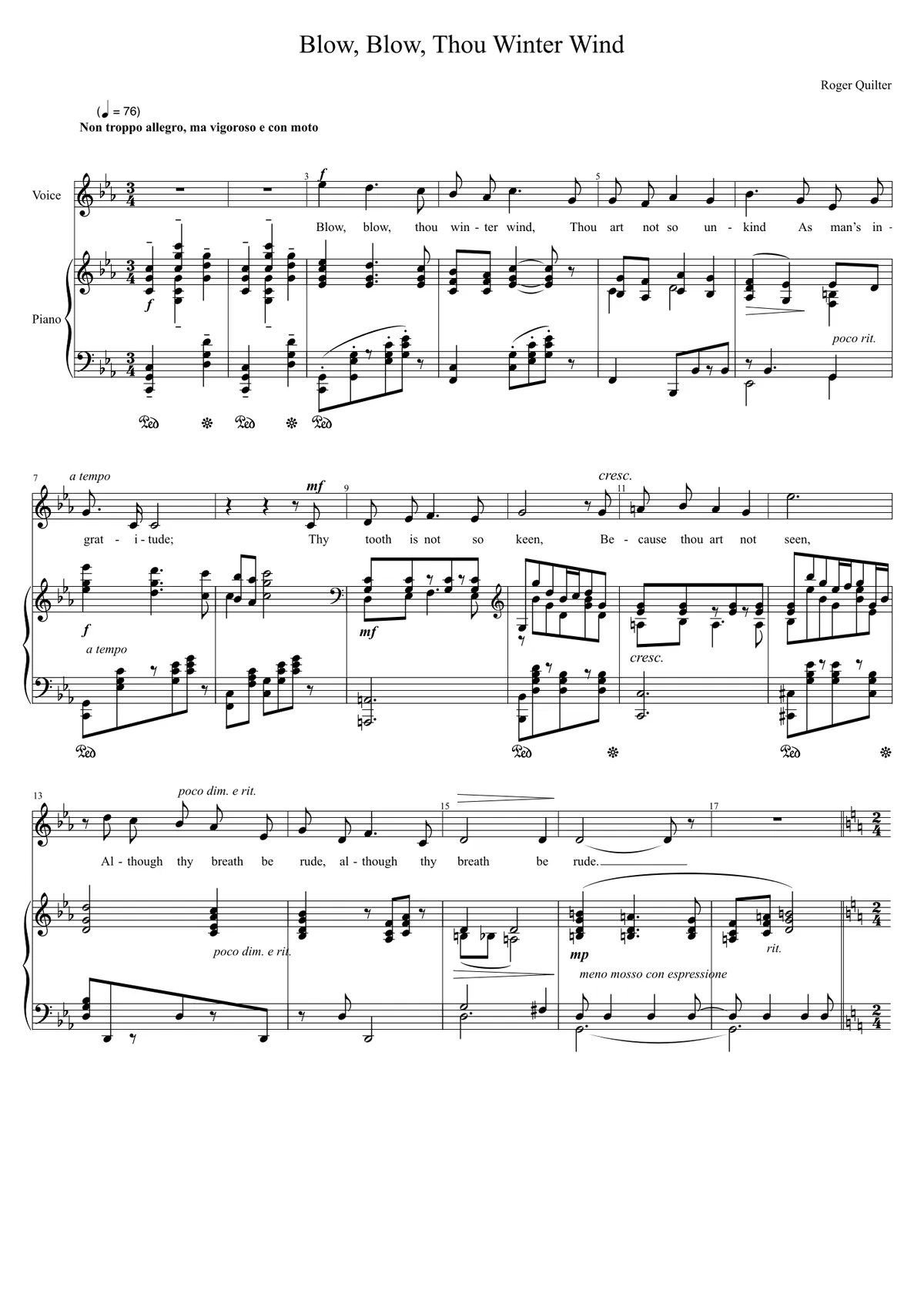
Blow, Blow, Thou Winter Wind closes Roger Quilter’s Three Shakespeare Songs, Op. 6, published by Boosey in 1905. The text is Amiens’ song from As You Like It: “Blow, blow, thou winter wind, thou art not so unkind as man’s ingratitude.” The winter wind bites less than a friend’s betrayal, and the freezing sky stings less than a friend forgotten. Each stanza ends with the defiant refrain, “Heigh-ho! sing heigh-ho! unto the green holly,” which concludes that most friendship is feigning and this life is most jolly.
Quilter sets it Non troppo allegro, ma vigoroso e con moto, in C minor with weighty, wind-driven piano chords. Each refrain changes key signature to C major and moves a little faster, Poco più allegro. This contrast between gruff verse and brighter refrain makes the song a strong closer for an English group and a favorite with lower voices.
What to practice
Treat the verses and refrains as two characters. The verses are forte and vigorous but should stay lyrical, not barked; let the piano provide the bluster. At each refrain, drop to piano for “Heigh-ho! sing heigh-ho!” and build the crescendo to the largamente on “Then heigh-ho, the holly!” where E5 arrives.
The ending is the longest stretch: “most jolly” carries E5 again in the final bars, so pace the second refrain to save energy. Diction carries the irony; enjoy the bite of “ingratitude” and “feigning,” and keep the long English vowels of “wind,” “unkind” and “holly” open. Rehearse the tempo changes at the poco dim. e rit. bars with the pianist so each refrain starts cleanly.
Who it suits
With a C4–E5 range in this edition, it suits baritone, bass-baritone and mezzo-soprano, and is a lively, audition-friendly choice for undergraduates who need an energetic English song.
Practicing it in Opusis
- Play the piano part on its own and sing over it: choose the voice part and switch to accompaniment practice, and the vocal line drops out.
- Move the song up or down by as much as an octave. The score is redrawn in the new key and the playback follows it.
- Set your own tempo and loop any passage until it sits.
Questions
- Which play is Blow, Blow, Thou Winter Wind from?
- Shakespeare’s As You Like It, where the courtier Amiens sings it in the Forest of Arden in Act II.
- Does the key change in Quilter’s Blow, Blow, Thou Winter Wind?
- Yes. The verses are in C minor and each Heigh-ho refrain shifts to C major, so the key signature changes three times in this edition and the song ends in C major.