Le Colibri (Ernest Chausson) — practice with piano accompaniment
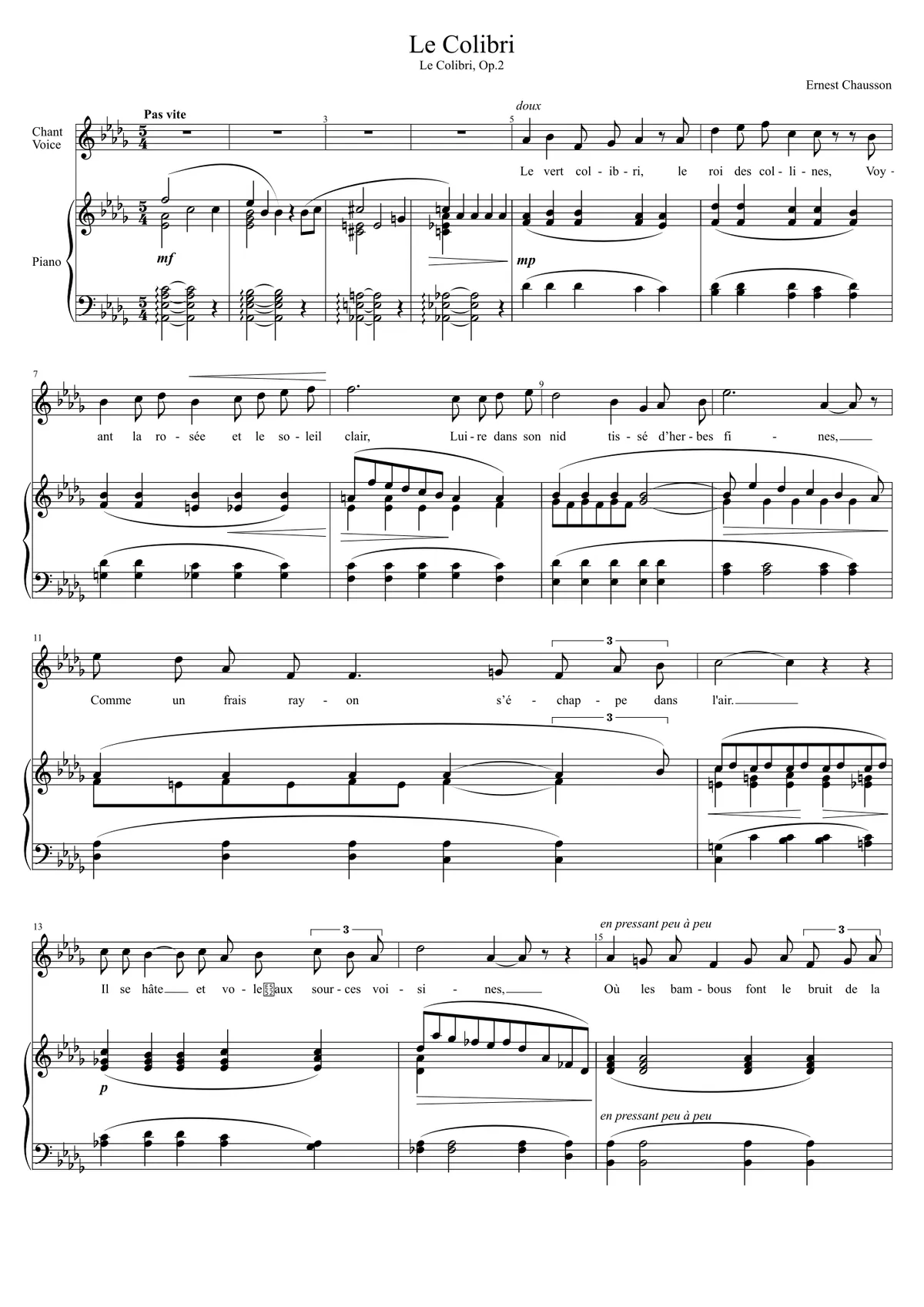
Chausson’s Le Colibri, Op.2 No.7: Leconte de Lisle text, D♭ major in 5/4, voice F4–G♭5. Notes for piano accompaniment practice.
About the song
Le Colibri (The Hummingbird) closes Ernest Chausson’s Sept mélodies, Op. 2, an early collection published by Hamelle. Leconte de Lisle’s poem begins “Le vert colibri, le roi des collines” — the green hummingbird, king of the hills — and follows the bird as it darts from its nest toward a cool spring, settles on a hibiscus blossom, and drinks so deeply from the flower that it dies. In the final stanza the poet turns the image toward his beloved: his own soul would gladly have died the same way, of the first kiss from her lips.
The song is best known for its meter. Chausson writes the whole piece in 5/4, which gives the line an unhurried, slightly suspended sway instead of a dance pulse. In this edition it is in D♭ major, five flats, with a quiet, flowing piano part under a long-breathed vocal melody. It is among the Chausson songs most often heard in voice studios, prized for showing legato and French line in a short span.
What to practice
Count the 5/4 aloud with the text before singing, and agree with your pianist on how each bar groups its beats, so the phrases breathe instead of stumbling. The tessitura sits between F4 and G♭5, in the upper middle of the voice, which rewards a steady, unforced legato over a big sound. Long phrases cross the bar lines, so mark breaths where the poem’s punctuation allows and keep vowels pure on held notes. Leconte de Lisle’s lines are rich in liquid consonants and open vowels; let them carry the line, and mark the final stanza’s turn from bird to beloved with a clear change of color.
Who it suits
Its upper-middle tessitura (F4–G♭5 here) suits lyric sopranos and tenors, and high mezzos with an easy top; it fits an upper-level undergraduate or graduate French group.
Practicing it in Opusis
- Play the piano part on its own and sing over it: choose the voice part and switch to accompaniment practice, and the vocal line drops out.
- Move the song up or down by as much as an octave. The score is redrawn in the new key and the playback follows it.
- Set your own tempo and loop any passage until it sits.
Questions
- What does Le Colibri mean?
- Le colibri is French for “the hummingbird.” The poem compares the bird dying of a flower’s sweetness to the poet’s wish to die of a first kiss.
- What time signature is Chausson’s Le Colibri in?
- It is written in 5/4 throughout, an unusual meter for a French song of its era and a large part of its floating character. It is No. 7, the last song, of Sept mélodies, Op. 2.