Hébé (Ernest Chausson) — practice with piano accompaniment
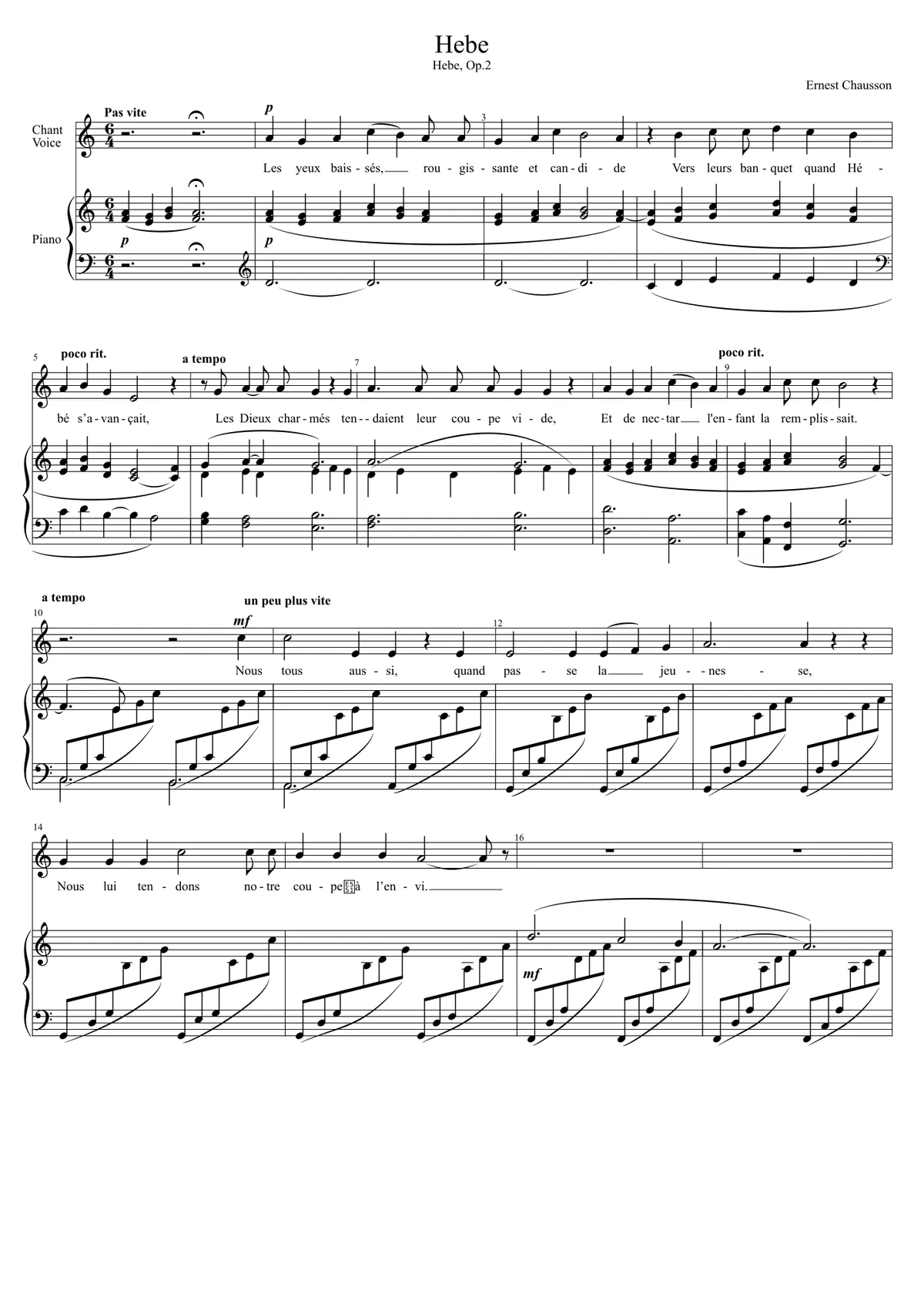
Chausson’s Hébé, Op. 2 No. 6, with piano accompaniment: Ackermann’s poem on fleeting youth, no key signature, 6/4, narrow E4–D5 range.
About the song
Hébé is the sixth of Ernest Chausson’s Sept mélodies, Op. 2, on a poem by Louise Ackermann. Hebe, the Greek goddess of youth, served nectar to the gods: “Les yeux baissés, rougissante et candide,” eyes lowered, blushing and innocent, she came toward their banquet, and they held out their empty cups to her. The poem then turns to us. We too hold out our cups to youth as she passes, but her visit is brief, and she fills them only for a moment before moving on.
Chausson writes without a key signature and gives the melody a modal, archaic color that suits the Greek subject, over a calm accompaniment in 6/4. The song is quiet and restrained, and in this edition the voice moves within the span of a seventh.
What to practice
With so little range, the interest has to come from color and line. Feel the 6/4 in two broad beats per bar; counting six small beats makes the song plod. Shape each phrase as one legato arc and keep the dynamic mostly soft, saving a little more voice for the turn from myth to human reflection.
French diction is central: the open-then-closed vowels of baissés, the nasal vowels of rougissante and candide, unaspirated initial consonants, and mute e’s sung lightly where the music gives them a note. Without a key signature, the modal inflections need careful tuning against the piano, so work slowly enough at first to hear each interval clearly.
Who it suits
Its E4–D5 range in this edition fits nearly any voice, and its restraint makes it a good early French mélodie for undergraduates, particularly mezzos and baritones looking for a quiet contrast within a set.
Practicing it in Opusis
- Play the piano part on its own and sing over it: choose the voice part and switch to accompaniment practice, and the vocal line drops out.
- Move the song up or down by as much as an octave. The score is redrawn in the new key and the playback follows it.
- Set your own tempo and loop any passage until it sits.
Questions
- Who is Hébé in Chausson’s song?
- Hebe is the Greek goddess of youth and cupbearer to the gods. Ackermann uses her as an image of youth, which passes quickly and does not linger.
- Is Chausson’s Hébé easy to sing?
- The range is narrow and the tempo calm, so it is technically approachable. The difficulty lies in sustaining a quiet legato and in polished French diction.
- Which collection is Hébé from?
- It is No. 6 of Chausson’s Sept mélodies, Op. 2. This edition was published by J. Hamelle in Paris in 1882.