The Year's at the Spring (Amy Beach) — practice with piano accompaniment
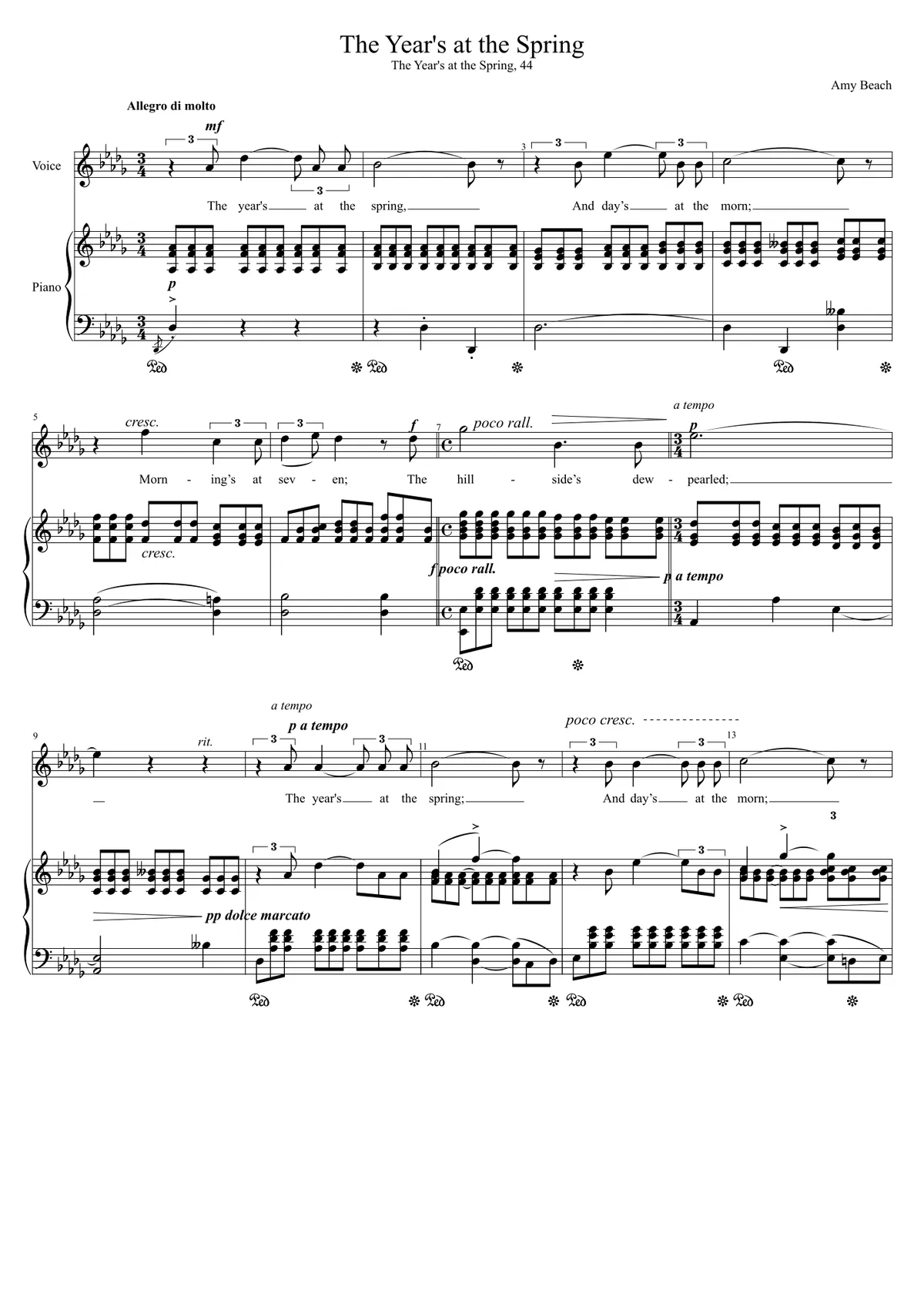
Amy Beach’s The Year’s at the Spring, Op.44 No.1: Browning text, D♭ major, 3/4, voice A♭4–A♭5. Piano accompaniment practice notes.
About the song
The Year’s at the Spring is the first of Amy Beach’s Three Browning Songs, Op. 44, published in Boston by Arthur P. Schmidt in 1900, and it became one of the best-loved American art songs of its day. The text is Pippa’s song from Robert Browning’s verse drama Pippa Passes: “The year’s at the spring, and day’s at the morn; morning’s at seven.” In eight short lines Browning builds a sunlit list — dew on the hillside, the lark on the wing, the snail on the thorn — and ends with the famous conclusion that God is in his heaven and all is right with the world.
Beach matches the poem’s breathless joy with a song of just 29 measures. In this edition it is in D♭ major and 3/4, with an eager, rushing piano part and a vocal line that keeps climbing toward the final exclamation. Its companions in Op. 44 are Ah, Love, but a Day! and I Send My Heart Up to Thee. Short, bright and in English, it is a favorite closer for an American set.
What to practice
With a range of A♭4 to A♭5, the song sits high from start to finish, so the challenge is tessitura rather than a single high note. Keep the voice buoyant and the vowels open, and do not over-darken to manage the top. The piano’s rapid figuration sets a fast pulse in 3/4; feel it in one per bar, and do not let it hurry you past the words. Browning’s lines are packed with consonants (spring, morn, dew-pearled, thorn), so practice the text in rhythm until it is effortless. Shape the whole song as one long rise in excitement, saving the most brilliance for the last lines.
Who it suits
In this edition it suits lyric and coloratura sopranos and tenors with a comfortable upper range, and it is a popular choice for high school contests, NATS auditions and undergraduate American song sets.
Practicing it in Opusis
- Play the piano part on its own and sing over it: choose the voice part and switch to accompaniment practice, and the vocal line drops out.
- Move the song up or down by as much as an octave. The score is redrawn in the new key and the playback follows it.
- Set your own tempo and loop any passage until it sits.
Questions
- Where does the text of The Year’s at the Spring come from?
- It is Pippa’s song from Robert Browning’s verse drama Pippa Passes (1841), sung by a young silk-mill worker on her one holiday of the year.
- What does God’s in his heaven, all’s right with the world mean in Browning’s poem?
- It is Pippa’s innocent summing-up of a perfect spring morning: everything in nature is where it should be. In Pippa Passes her untroubled joy stands in contrast to the darker events unfolding around her.