Ah, Love, but a Day! (Amy Beach) — practice with piano accompaniment
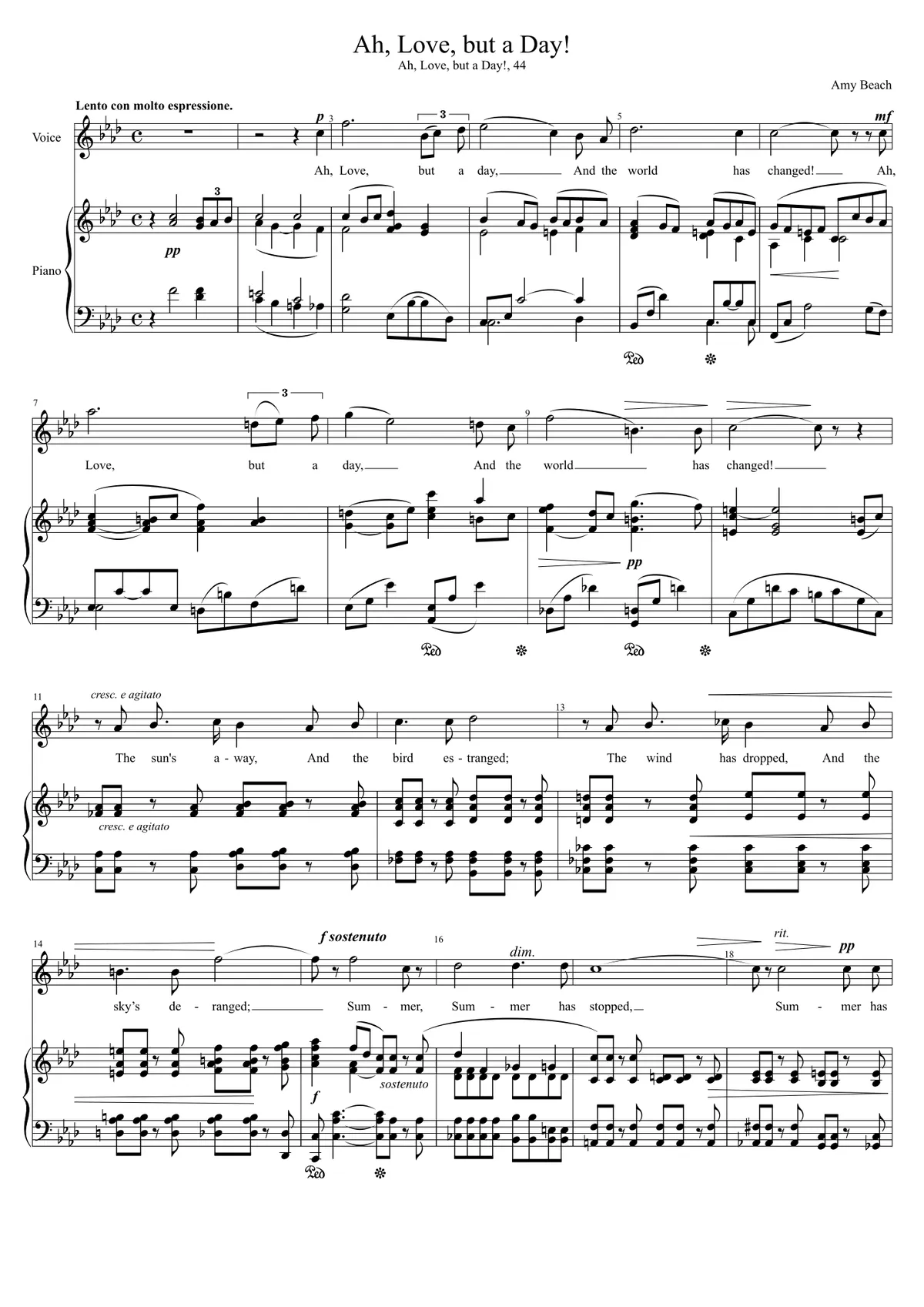
Amy Beach's Ah, Love, but a Day!, Op. 44 No. 2, a dramatic Browning song for high voice. Diction and pacing tips for piano accompaniment practice.
About the song
Ah, Love, but a Day! is the second of Amy Beach's Three Browning Songs, Op. 44, published by Arthur P. Schmidt in Boston in 1900 alongside The Year's at the Spring and I Send My Heart Up to Thee. The text is by Robert Browning. In the first stanza, "Ah, Love, but a day, and the world has changed!" the speaker notices that the sun has gone, the wind has dropped and summer has stopped. The second stanza turns to the beloved: look in my eyes, will you change too?
Beach builds the two stanzas from anxious, broken phrases into a broad, passionate climax. This edition has a four-flat key signature, includes a change of key, and asks for a high voice from E♭4 to A5. It is a staple of American art song and a frequent choice for singers who want an English-language piece with real dramatic range.
What to practice
Pacing the drama is the main task. The short opening phrases need urgency without shouting, so keep plenty in reserve for the later climax around A5. Practice the high passages in full to build stamina, and mark breaths that let you sustain the final lines.
English diction should be clear but not fussy: sing through the vowels, place final consonants such as changed, estranged and deranged precisely and together with the piano, and avoid overly dark vowels that cloud the words. The piano part is rich and active, so balance matters; rehearse the key change and the big moments with your pianist to agree on tempo shifts and breathing room.
Who it suits
This edition suits a soprano or tenor with a secure top, and it works as a strong English selection for upper-level undergraduates, graduate students and competition repertoire lists.
Practicing it in Opusis
- Play the piano part on its own and sing over it: choose the voice part and switch to accompaniment practice, and the vocal line drops out.
- Move the song up or down by as much as an octave. The score is redrawn in the new key and the playback follows it.
- Set your own tempo and loop any passage until it sits.
Questions
- What set is Ah, Love, but a Day! from?
- It is No. 2 of Amy Beach's Three Browning Songs, Op. 44, along with The Year's at the Spring and I Send My Heart Up to Thee.
- What is the highest note in Ah, Love, but a Day!?
- In this edition the voice reaches A5 near the climax, and the full range is E♭4 to A5, so it is best for high voices.
- Is Ah, Love, but a Day! good for a NATS competition?
- It is a common choice for an American or English-language slot, but its sustained high writing and top notes suit more advanced singers better than beginners.