Träume (Richard Wagner) — practice with piano accompaniment
Wagner Träume, Wesendonck Lieder No. 5: Mathilde Wesendonck text, the Tristan connection, legato tips, and piano accompaniment practice.
About the song
Träume (Dreams) is the fifth of Richard Wagner’s Wesendonck Lieder, WWV 91, five songs on poems by Mathilde Wesendonck, published for a woman’s voice and piano. Wagner labeled it a study for Tristan und Isolde, and its music returns in the Act II love duet. The poem begins “Sag’, welch wunderbare Träume halten meinen Sinn umfangen”: tell me, what wonderful dreams hold my senses captive, dreams that have not vanished like empty foam into nothingness? They grow lovelier each day, sink into the soul like sacred rays, and bloom like flowers kissed by the spring sun, only to fade on the beloved’s breast and sink into the grave.
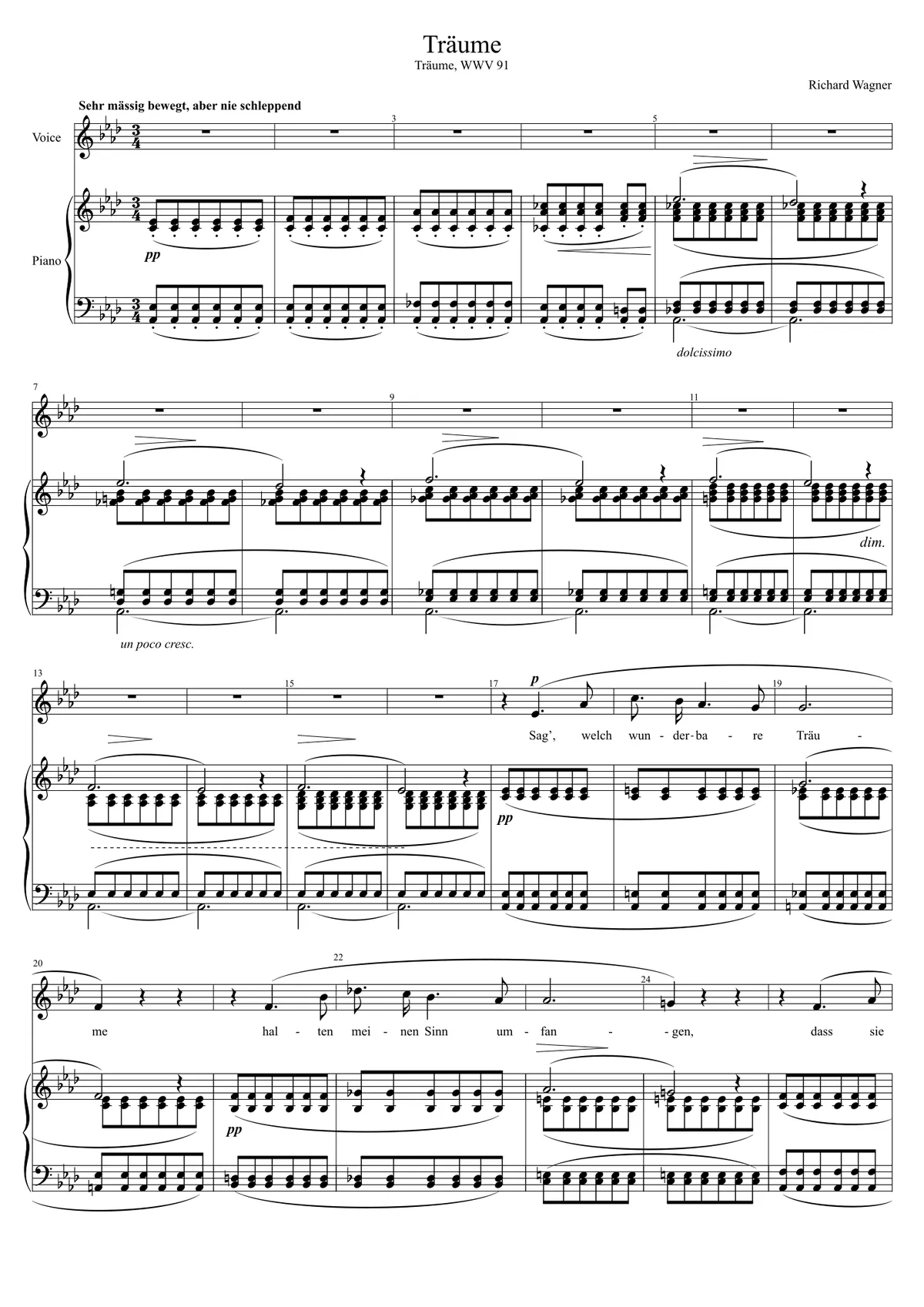
In A♭ major, the score asks for Sehr mässig bewegt, aber nie schleppend: moving very moderately, but never dragging. Repeated eighth-note chords pulse under long, slowly unfolding vocal phrases, and the piano’s sixteen-bar introduction and long postlude frame the voice.
What to practice
The marking “never dragging” is the key. The phrases are long and slow, so plan breaths that keep the line moving and do not let the throbbing chords pull you behind the beat.
Most of the song is p or pp, with dolcissimo in the introduction. The voice opens up at “Träume, wie wenn Frühlingssonne,” forte, and reaches G♭5 at “Wonne,” then pulls back gradually, nachlassend, toward the end. Practice that span as one arc. Wagner’s German needs legato through consonants: connect “Sinn umfangen” and “öden Nichts vergangen” without stopping the tone, and keep the vowels of “Träume” and “Wonne” long.
Who it suits
The C4–G♭5 range in this edition suits soprano or mezzo-soprano with a rich middle voice and good breath control; it is a fine first Wagner song for graduate students and advanced undergraduates.
Practicing it in Opusis
- Play the piano part on its own and sing over it: choose the voice part and switch to accompaniment practice, and the vocal line drops out.
- Move the song up or down by as much as an octave. The score is redrawn in the new key and the playback follows it.
- Set your own tempo and loop any passage until it sits.
Questions
- Why is Träume called a study for Tristan und Isolde?
- Wagner gave it that label himself, and the music returns in the love duet of Act II of the opera, which he was composing at the time.
- Is Träume for a male or female voice?
- The Wesendonck Lieder were published for a woman’s voice and are usually sung by sopranos and mezzo-sopranos.