Élégie (Jules Massenet) — practice with piano accompaniment
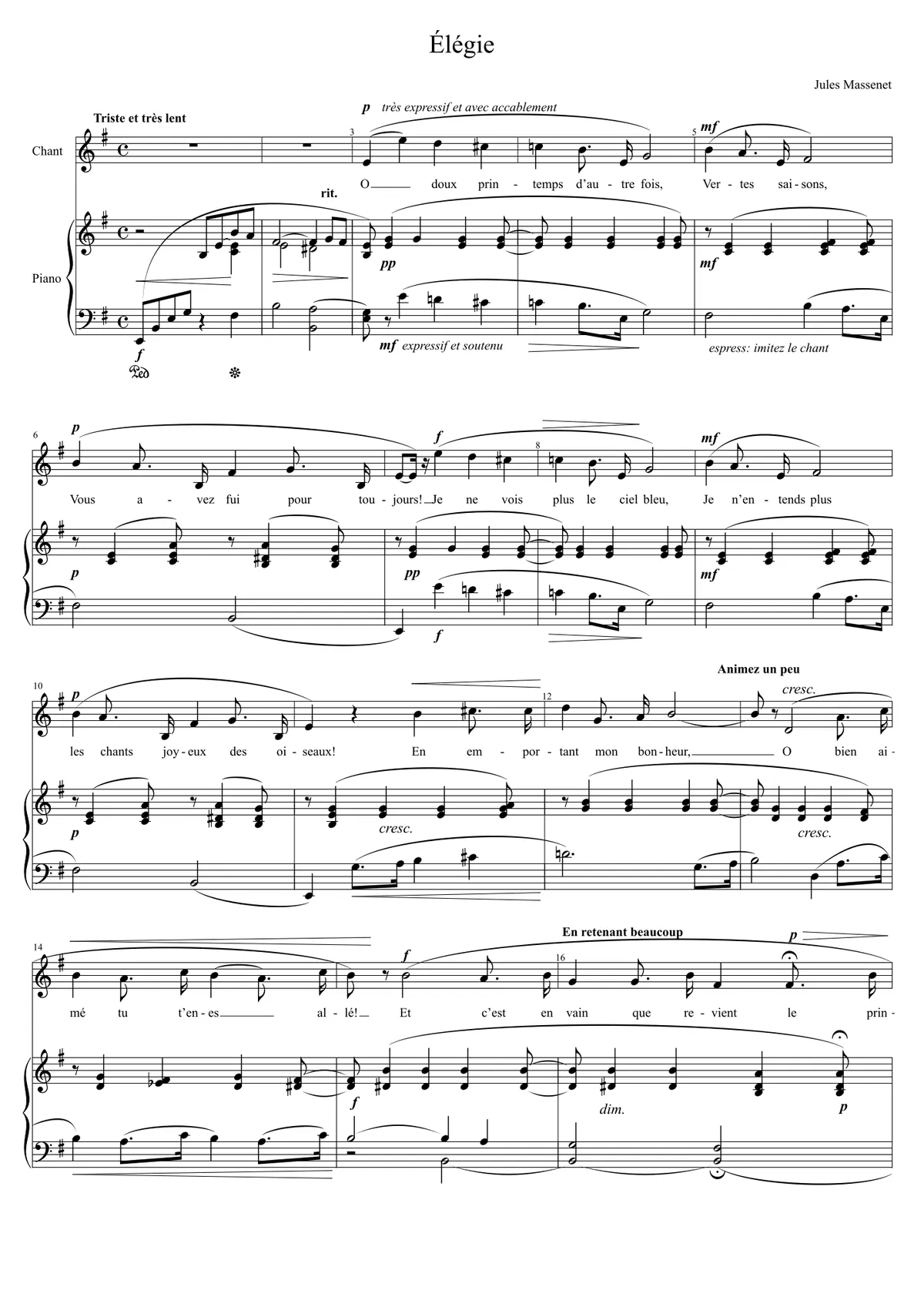
Massenet’s Élégie with piano accompaniment: Louis Gallet’s lament for lost springtime in E minor, 4/4, voice B3–F5. A short, lyrical French song.
About the song
Élégie is Jules Massenet’s best-known song, a brief lament on a text by Louis Gallet, who also wrote librettos for Massenet’s operas, Thaïs among them. The opening, “Ô doux printemps d’autrefois, vertes saisons,” calls back to the sweet springs and green seasons of the past, which have fled for good. The speaker no longer sees a blue sky or hears the birds; joy has gone with the beloved, and the heart’s springtime has gone too.
The melody unfolds in long, falling arcs in E minor over a supportive accompaniment, and the tune is familiar from many instrumental arrangements as well; some performers add a cello or violin obbligato. At 27 measures it is short, but it asks for a true legato and real grief without melodrama.
What to practice
Élégie looks simple and is easy to oversing. Keep the tempo moving enough to take each phrase in one breath, and shape the falling lines so the sigh at the end of a phrase lands softly instead of sagging in pitch.
French diction is the main study. Avoid stressing final syllables beyond the natural phrase accent, keep the vowel of doux round and forward, and do not close the nasal vowel of printemps with a hum. The emotional peak near the top of the range wants warmth rather than volume. Because the piano mostly supports rather than leads, the singer carries the line; listen to the bass so the harmony guides your rubato, and agree with your pianist on where the music breathes.
Who it suits
With a range of B3–F5 in this edition, it suits mezzo-sopranos and baritones as well as lyric sopranos and tenors with a warm middle voice, and it makes a good first French song for intermediate students.
Practicing it in Opusis
- Play the piano part on its own and sing over it: choose the voice part and switch to accompaniment practice, and the vocal line drops out.
- Move the song up or down by as much as an octave. The score is redrawn in the new key and the playback follows it.
- Set your own tempo and loop any passage until it sits.
Questions
- What is Massenet’s Élégie about?
- An élégie is a lament. Gallet’s poem mourns the lost springtime of the past as an image of lost love and happiness.
- Does Massenet’s Élégie have an opus number?
- It is usually listed without one. This edition was published by G. Hartmann in Paris in 1893.
- Is Élégie a good song for a mezzo or baritone?
- Yes. In this E minor edition the voice moves between B3 and F5, which sits comfortably in the middle of most mezzo and baritone voices.