The Mermaid's Song (Joseph Haydn) — practice with piano accompaniment
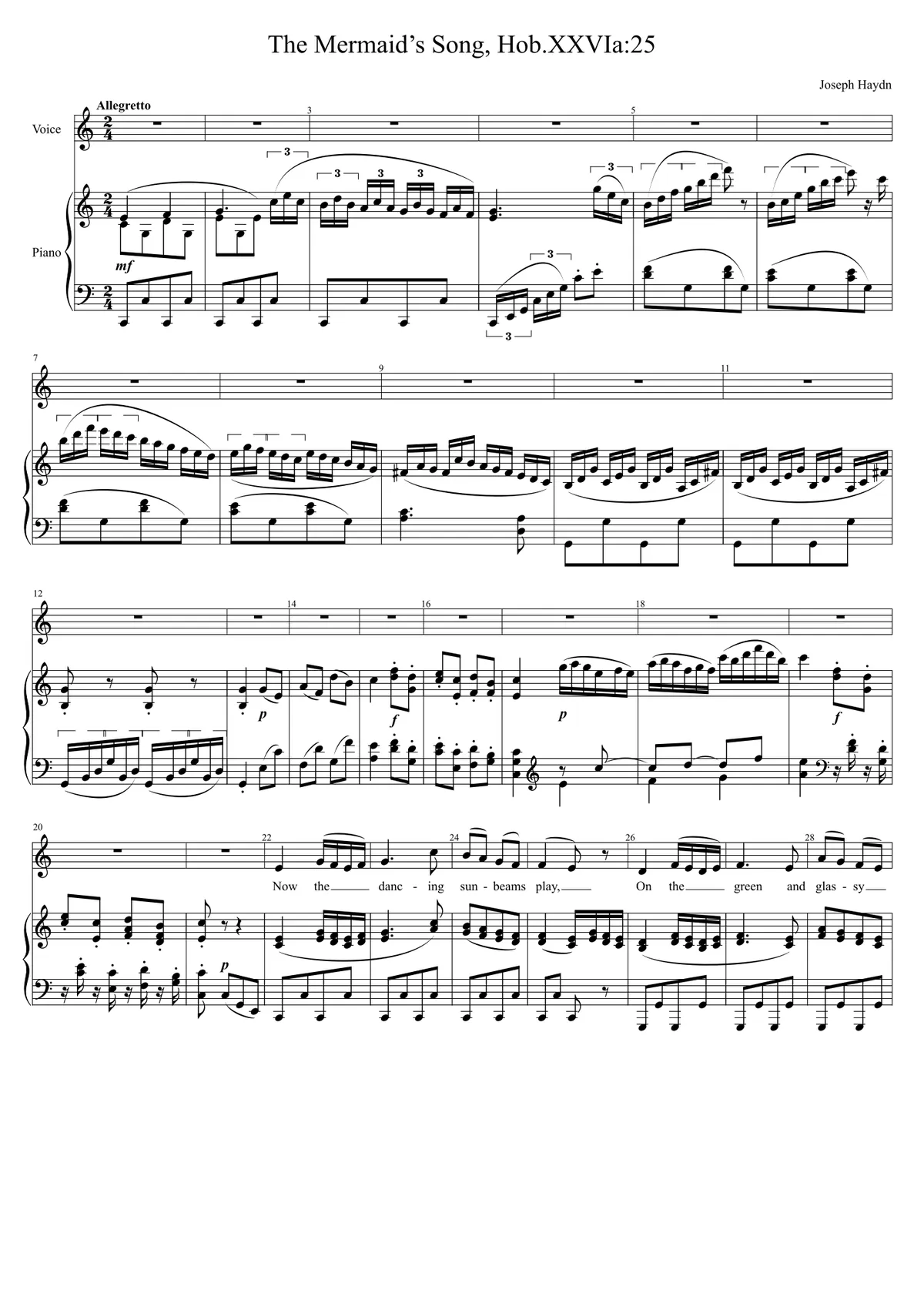
Haydn’s The Mermaid’s Song, Hob.XXVIa:25: Anne Hunter text, C major, 2/4, voice C4–G5. Practice notes for singing with the piano part.
About the song
The Mermaid’s Song opens the first set of Haydn’s Six Original Canzonettas, English songs he wrote for the London public during his visits to England in the 1790s. The words are by Anne Hunter, a poet and the wife of the surgeon John Hunter, who wrote the texts for several of Haydn’s English songs. A mermaid calls a listener down to her world beneath the waves: “Now the dancing sunbeams play on the green and glassy sea,” she sings, and she promises to lead the way to the place where pearls lie and coral grows.
Haydn writes a cheerful C major song in 2/4 with a keyboard part that has a real role of its own, including an introduction, interludes and figuration that suggests rippling water. The style is classical — clear phrases, simple harmony, crisp rhythm — and that clarity makes it a favorite teaching piece and a natural doorway into the canzonettas as a whole.
What to practice
At 129 short measures of 2/4, the song moves along, so keep the pulse light and think in one or two beats to the bar rather than marching. The voice spans C4 to G5, and clean intonation and rhythmic precision are the main tasks. Classical style asks for even eighth notes, no sliding between pitches, and phrase endings that taper rather than stop. In English, aim for natural speech: crisp t’s and d’s, and pure, unspread vowels on the many long e sounds such as sea and be. Treat the piano interludes as part of the scene, and keep the mermaid’s invitations playful and coaxing rather than heavy.
Who it suits
In this edition (C4–G5) it suits high voices, especially young lyric sopranos and tenors, and is a solid classical-period choice for high school contests, NATS student auditions and early undergraduate juries.
Practicing it in Opusis
- Play the piano part on its own and sing over it: choose the voice part and switch to accompaniment practice, and the vocal line drops out.
- Move the song up or down by as much as an octave. The score is redrawn in the new key and the playback follows it.
- Set your own tempo and loop any passage until it sits.
Questions
- Who wrote the words to Haydn’s The Mermaid’s Song?
- Anne Hunter, a London poet whose verses Haydn set in his English canzonettas. She was the wife of the surgeon John Hunter.
- Which collection is The Mermaid’s Song from?
- It is the first song of Haydn’s first set of Six Original Canzonettas, catalogued as Hob. XXVIa:25.
- Is The Mermaid’s Song good for a beginning singer?
- Yes, for a high voice with a reasonably secure G5. Its clear classical phrases make it a common early-level piece, though the quick pace calls for precise diction.