Sleep (Ivor Gurney) — practice with piano accompaniment
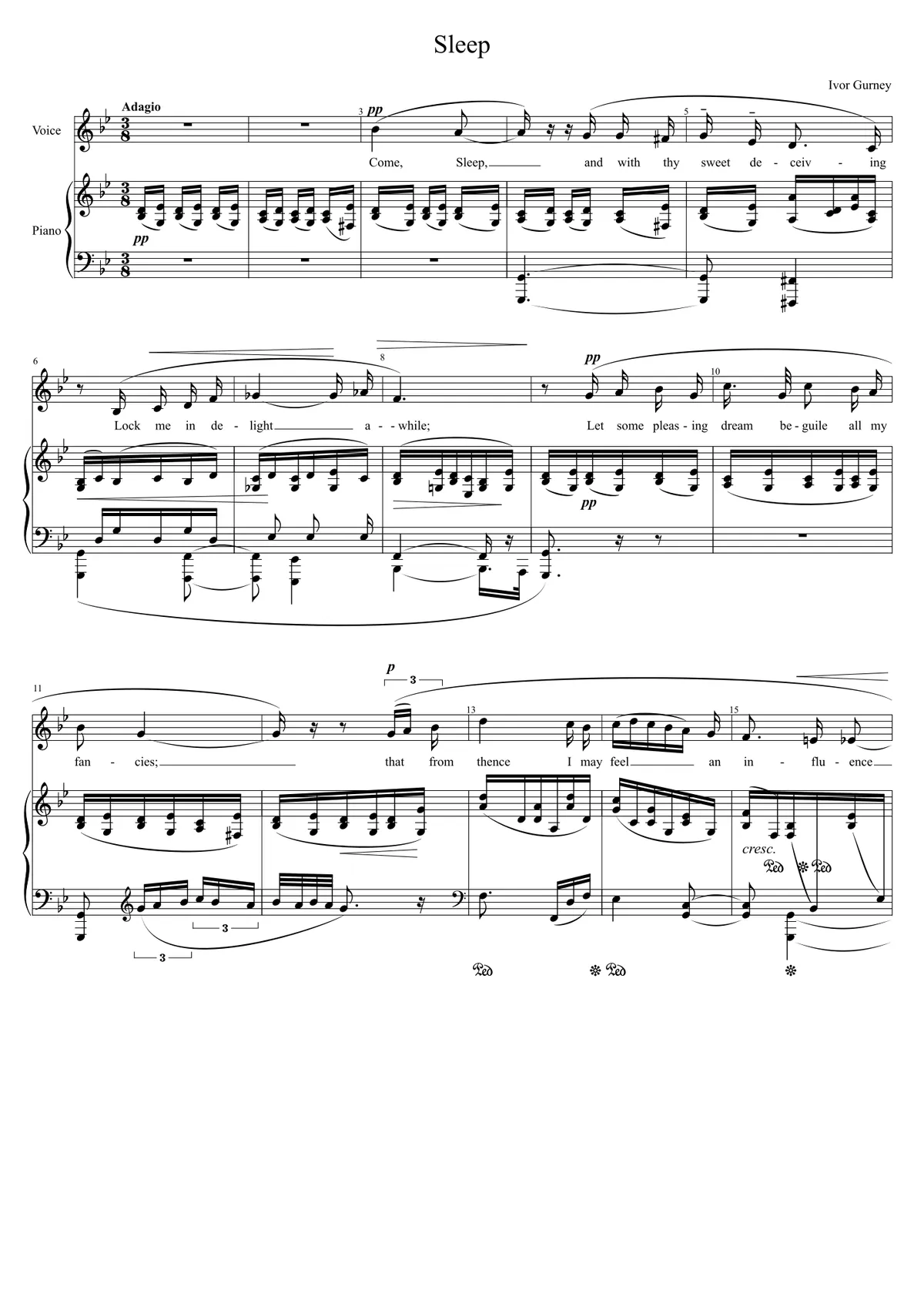
Ivor Gurney’s Sleep from Five Elizabethan Songs: John Fletcher text, 3/8, voice B♭3–F5. Practice notes for the piano accompaniment.
About the song
Sleep is the fourth of Ivor Gurney’s Five Elizabethan Songs, a set singers often call “the Elizas,” and it is one of the most performed English songs of its generation. The words are by the Jacobean playwright John Fletcher: “Come, Sleep, and with thy sweet deceiving lock me in delight awhile.” The speaker begs sleep to bring pleasant dreams, even false ones, because those who suffer long are content with a passing illusion, and the poem closes with a plea that such joys might last.
Gurney sets it slowly in 3/8, with rich, shifting harmonies in the piano beneath a long-arching vocal line. The music grows from a hushed opening to an intense climax and sinks back into quiet. This edition, published by Winthrop Rogers in 1920, is written with two flats in the key signature. The other songs in the set are Orpheus, Tears, Under the Greenwood Tree and Spring. Singers choose Sleep for its depth of feeling in a short span and its demands on line and color in English.
What to practice
The range here is wide, from B♭3 to F5, so the opening and the climax ask for different colors from the same instrument: a warm, speech-clear low register and a full but unforced top. In a slow 3/8, think in spans of several bars rather than counting every eighth note, and let the piano’s harmonic changes guide your rubato. English diction is the trap: keep the consonants of deceiving and delight clean without chopping the line to make them. Plan breaths around Fletcher’s punctuation, since several sentences run across phrase breaks. The return to quiet after the climax needs as much support as the loudest passage.
Who it suits
Its range in this edition (B♭3–F5) suits mezzo-sopranos and lyric sopranos with a solid lower register, as well as tenors, and it rewards an English group on a graduate or advanced undergraduate recital.
Practicing it in Opusis
- Play the piano part on its own and sing over it: choose the voice part and switch to accompaniment practice, and the vocal line drops out.
- Move the song up or down by as much as an octave. The score is redrawn in the new key and the playback follows it.
- Set your own tempo and loop any passage until it sits.
Questions
- What are Gurney’s Five Elizabethan Songs?
- A set of five songs to Elizabethan and Jacobean texts: Orpheus, Tears, Under the Greenwood Tree, Sleep and Spring. Sleep is No. 4.
- Who wrote the words to Gurney’s Sleep?
- The poem Come, Sleep, and with thy sweet deceiving is by John Fletcher, the playwright known for his collaborations with Francis Beaumont and with Shakespeare.