Spirate pur, spirate (Stefano Donaudy) — practice with piano accompaniment
Donaudy Spirate pur, spirate, 36 Arie di stile antico No. 10: Italian text, diction and line tips, and piano accompaniment practice.
About the song
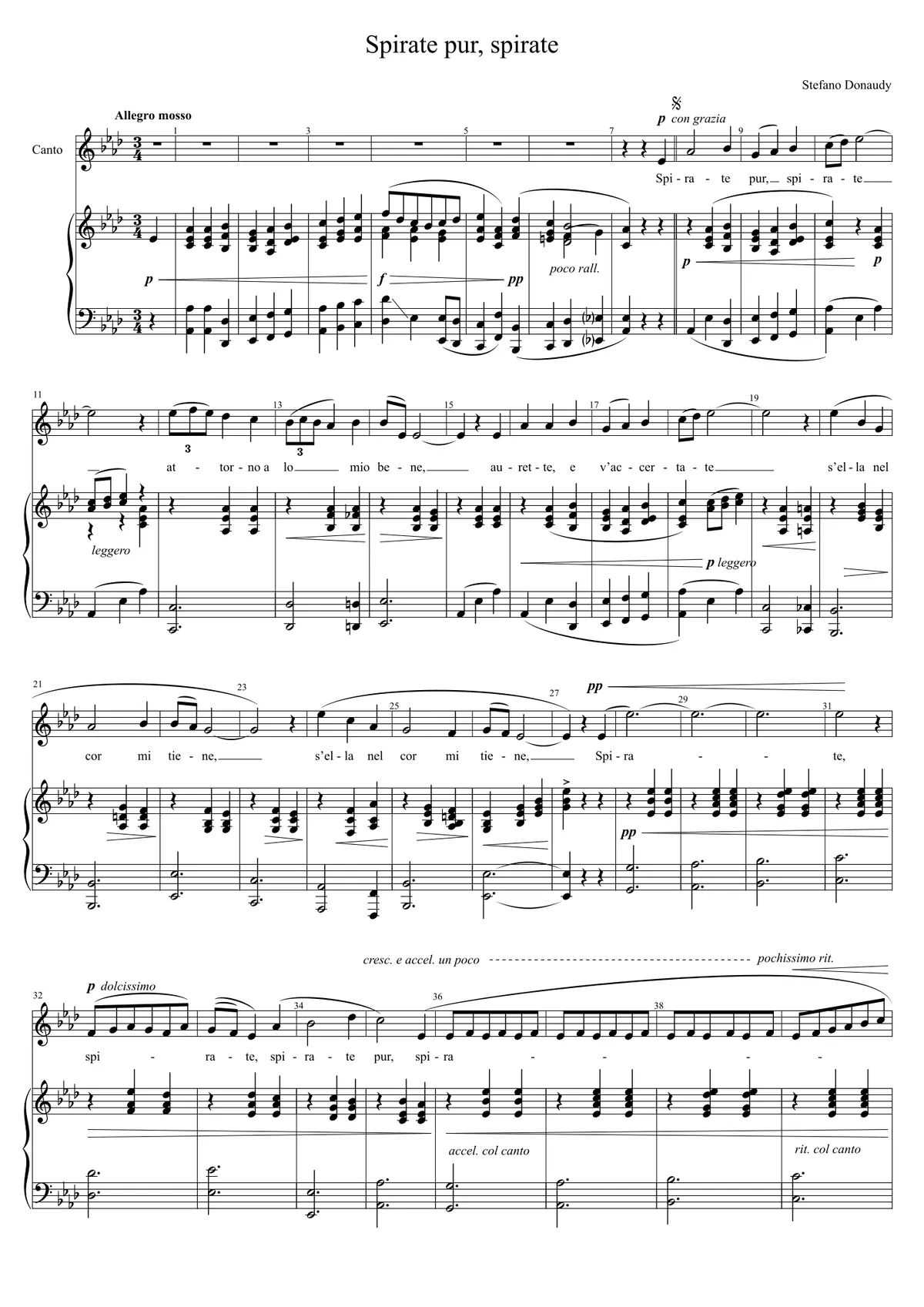
Spirate pur, spirate is No. 10 of Stefano Donaudy’s 36 Arie di stile antico, songs written in the twentieth century in the manner of older Italian arias, with texts by his brother Alberto Donaudy. The speaker calls to the breezes: “Spirate pur, spirate attorno a lo mio bene,” blow, little breezes, around my beloved, and find out whether she holds me in her heart. In the middle section he begs the light, blessed breezes to bring him that assurance.
Despite the antique title, the harmony and lyricism are late Romantic. The song is marked Allegro mosso, con grazia, over light quarter-note chords in 3/4, and ends with a D.S. al Fine, so the opening section returns after the middle part. With its graceful line, it is a favorite among the Donaudy songs for students and competitions.
What to practice
Keep it graceful and buoyant. The piano marks leggero, and the voice should stay light and forward. Feel the 3/4 in one rather than three so the lines spin. The middle section, “Se nel suo cor mi tiene,” grows from p through mf to a largamente forte at “V’accertate, aure beate,” where G5 appears. Broaden there without slowing too much, then follow the rall. and dolcissimo back into the return of the opening.
Italian diction is the other half of the work. Lean into the double consonants in “attorno,” “aurette” and “accertate,” keep the vowels pure in “spirate,” and remember the archaic “a lo mio bene.” Mark the many small tempo changes, accel., rit. and a tempo, with the pianist so they feel natural rather than fussy.
Who it suits
With an E♭4–G5 range in this edition, it suits soprano or tenor and is a strong Italian choice for early undergraduates who have moved beyond the 24 Italian Songs and Arias.
Practicing it in Opusis
- Play the piano part on its own and sing over it: choose the voice part and switch to accompaniment practice, and the vocal line drops out.
- Move the song up or down by as much as an octave. The score is redrawn in the new key and the playback follows it.
- Set your own tempo and loop any passage until it sits.
Questions
- What does Spirate pur, spirate mean?
- Roughly, Blow, then, blow. The singer asks the breezes to blow around the beloved and find out whether she cares for him.
- Is Spirate pur, spirate a Baroque aria?
- No. It comes from Stefano Donaudy’s 36 Arie di stile antico, early twentieth-century songs that evoke an older style but use Romantic harmony.
- What does aurette mean in Spirate pur, spirate?
- Aurette means little breezes, a diminutive of aure. The singer asks them to blow around the beloved and find out whether she holds him in her heart.