Mandoline (Claude Debussy) — practice with piano accompaniment
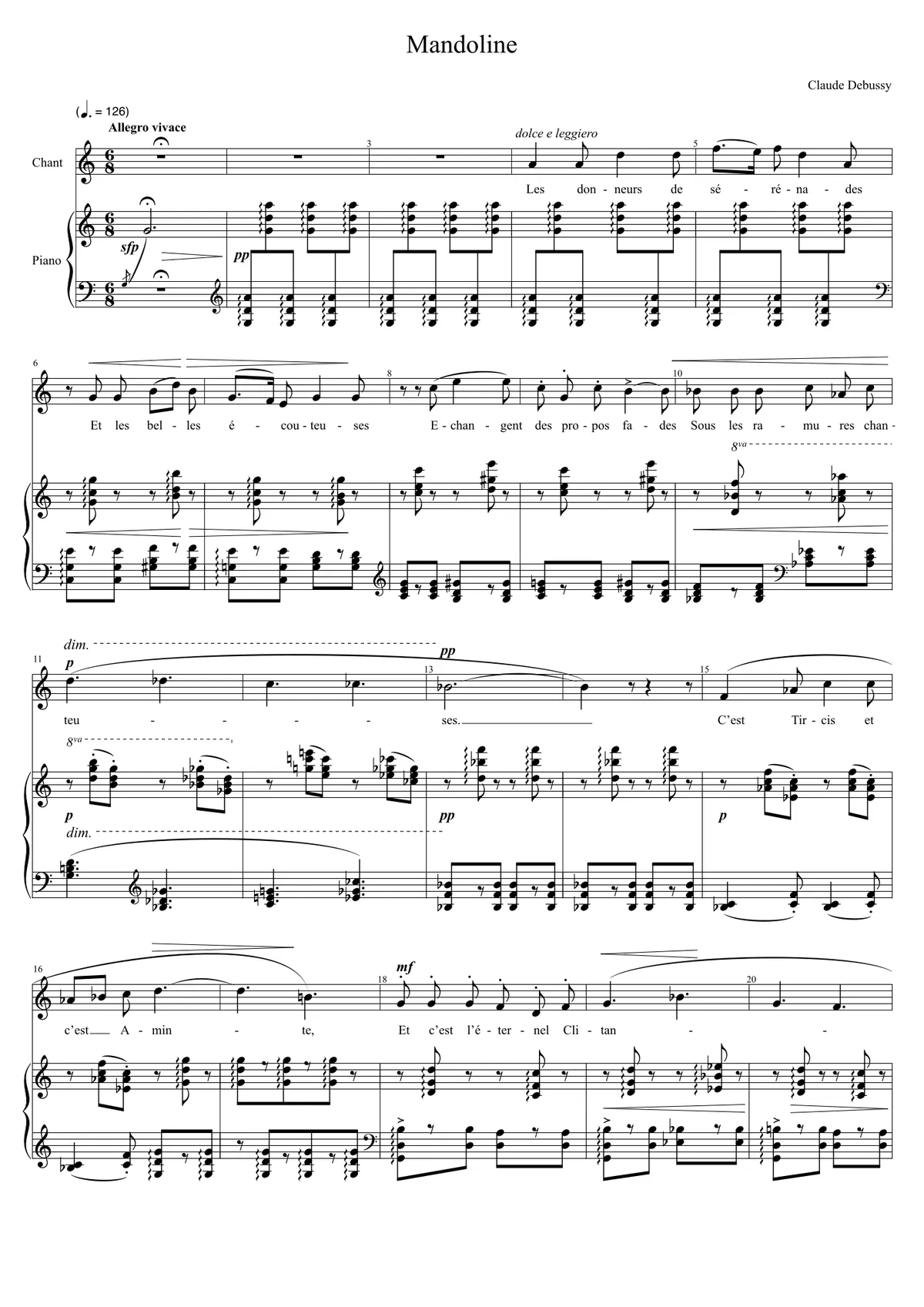
Debussy’s early Verlaine song Mandoline: no key signature, 6/8, voice C4–G5, 70 bars. Practice notes for the piano accompaniment.
About the song
Debussy set Verlaine’s Mandoline as a young composer, long before Pelléas et Mélisande, and it remains one of his most frequently sung early songs. The text is the same Fêtes galantes poem Fauré later set: “Les donneurs de sérénades et les belles écouteuses” — serenaders and the ladies who listen to them — exchange idle compliments beneath the trees, while the masked lovers of the old pastoral stage turn and sway and a mandolin chatters under the moon.
Debussy’s version is quicker and more mischievous than Fauré’s. The piano opens with dry open fifths in 6/8 that evoke a plucked instrument, and the voice ends with a run of carefree “la, la” syllables. The score carries no key signature, and the harmony slips through unexpected keys before finding its way home. Light and quick, it makes a crisp encore or a bright close to a French set.
What to practice
The range in this edition runs from C4 to G5, wider than Fauré’s setting, and the top notes arrive quickly in light, speech-like rhythm, so they need to be placed rather than pushed. Feel two beats per bar and keep the eighth notes buoyant; the accompaniment gives you the pulse, and the voice should ride on top of it without dragging. Practice the French in rhythm at speaking speed before adding pitch, with special care for the names Tircis, Aminte, Clitandre and Damis and the quick schwa syllables. The closing la-la passage needs agility and a smile in the tone; keep it on the breath and hold the tempo until the score itself relaxes it.
Who it suits
In this edition it fits light lyric sopranos and high mezzos best, and tenors sing it as well; it is a good showcase for an undergraduate with clean French diction and an easy top.
Practicing it in Opusis
- Play the piano part on its own and sing over it: choose the voice part and switch to accompaniment practice, and the vocal line drops out.
- Move the song up or down by as much as an octave. The score is redrawn in the new key and the playback follows it.
- Set your own tempo and loop any passage until it sits.
Questions
- How is Debussy’s Mandoline different from Fauré’s?
- Both set the same Verlaine poem. Debussy’s is faster, wider in range in these editions (C4–G5 against Fauré’s D4–E5) and ends with playful “la, la” syllables, while Fauré’s is cooler and more restrained.
- Is Debussy’s Mandoline part of his Fêtes galantes?
- No. It is a separate early song and does not belong to either of Debussy’s two sets titled Fêtes galantes, even though the poem comes from Verlaine’s book of that name.
- What do the la, la syllables at the end of Debussy’s Mandoline mean?
- They carry no words; the voice takes over the chattering of the mandolin in the poem’s last lines. Sing them lightly and in strict rhythm, as part of the serenade rather than as a vocal display.