Liebst du um Schönheit (Clara Schumann) — practice with piano accompaniment
Clara Schumann's Liebst du um Schönheit, Op. 12 No. 4, a Rückert song in D♭ major. Stanza shaping tips for piano accompaniment practice.
About the song
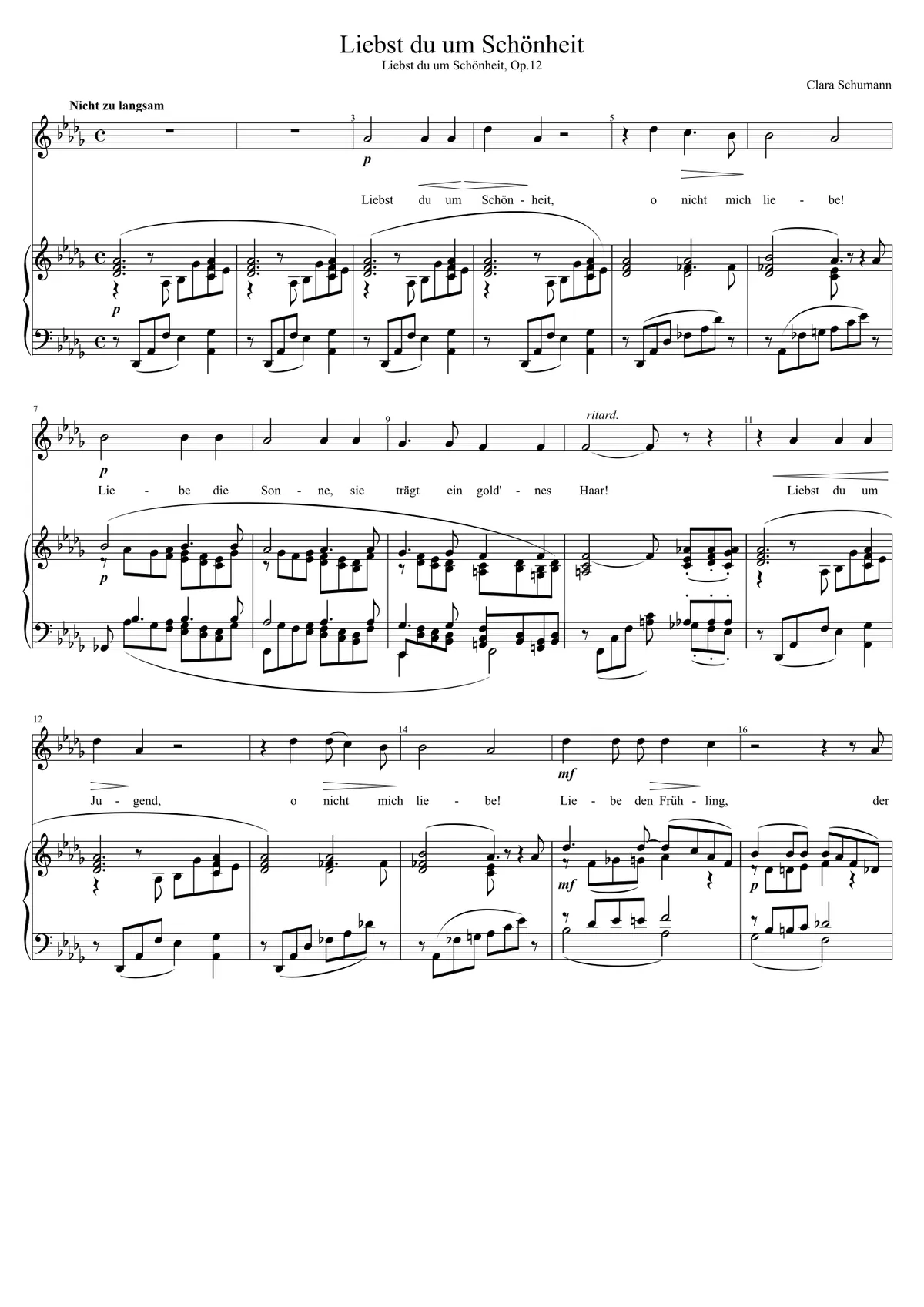
Liebst du um Schönheit is one of the three songs Clara Schumann contributed to a joint publication with Robert of twelve poems from Friedrich Rückert's Liebesfrühling; her songs appeared as her Op. 12. The poem is built on a simple, persuasive pattern. It begins "Liebst du um Schönheit, o nicht mich liebe": if you love for beauty, do not love me, love the sun with its golden hair. Youth and riches get the same answer, pointing to spring and the mermaid instead. Only in the last stanza comes the turn: if you love for love's sake, then love me, and I will love you always.
In this edition the song is in D♭ major, in 4/4, with a range of F4 to E♭5, over 41 measures. Clara keeps the stanzas closely related while letting the final one open warmly. Singers program it because it is graceful and approachable, and because it offers a well-crafted song by a major nineteenth-century woman composer.
What to practice
The song's structure is its expressive engine. Sing the first three stanzas with a gentle, almost teasing refusal, and save a fuller, more generous tone for Liebst du um Liebe so the change of answer lands. Avoid making all four stanzas sound alike; vary color and dynamics with the text.
The range is moderate, but the line needs an even, unforced connection as it rises toward E♭5. Practice clean German diction on Schönheit, Jugend and Schätze, keeping consonants clear without breaking the legato. Settle the tempo with your pianist so the song flows, and agree on how much to broaden at the final phrase.
Who it suits
It suits a lyric soprano, mezzo or tenor at the high school or early undergraduate level, and pairs well with Robert Schumann songs in a recital set.
Practicing it in Opusis
- Play the piano part on its own and sing over it: choose the voice part and switch to accompaniment practice, and the vocal line drops out.
- Move the song up or down by as much as an octave. The score is redrawn in the new key and the playback follows it.
- Set your own tempo and loop any passage until it sits.
Questions
- Did Mahler set Liebst du um Schönheit too?
- Yes. Gustav Mahler also set this Rückert poem, as one of his Rückert-Lieder. Clara Schumann's earlier version is a separate, shorter song for voice and piano.
- What collection is Clara Schumann's Op. 12 from?
- Op. 12 is Clara's share of a joint Rückert collection with Robert Schumann, drawn from the poet's Liebesfrühling. She contributed three of the twelve songs, and this is one of them.