Is My Team Ploughing? (George Butterworth) — practice with piano accompaniment
Butterworth Is My Team Ploughing?, A Shropshire Lad No. 6: Housman dialogue, voicing two characters, and piano accompaniment practice.
About the song
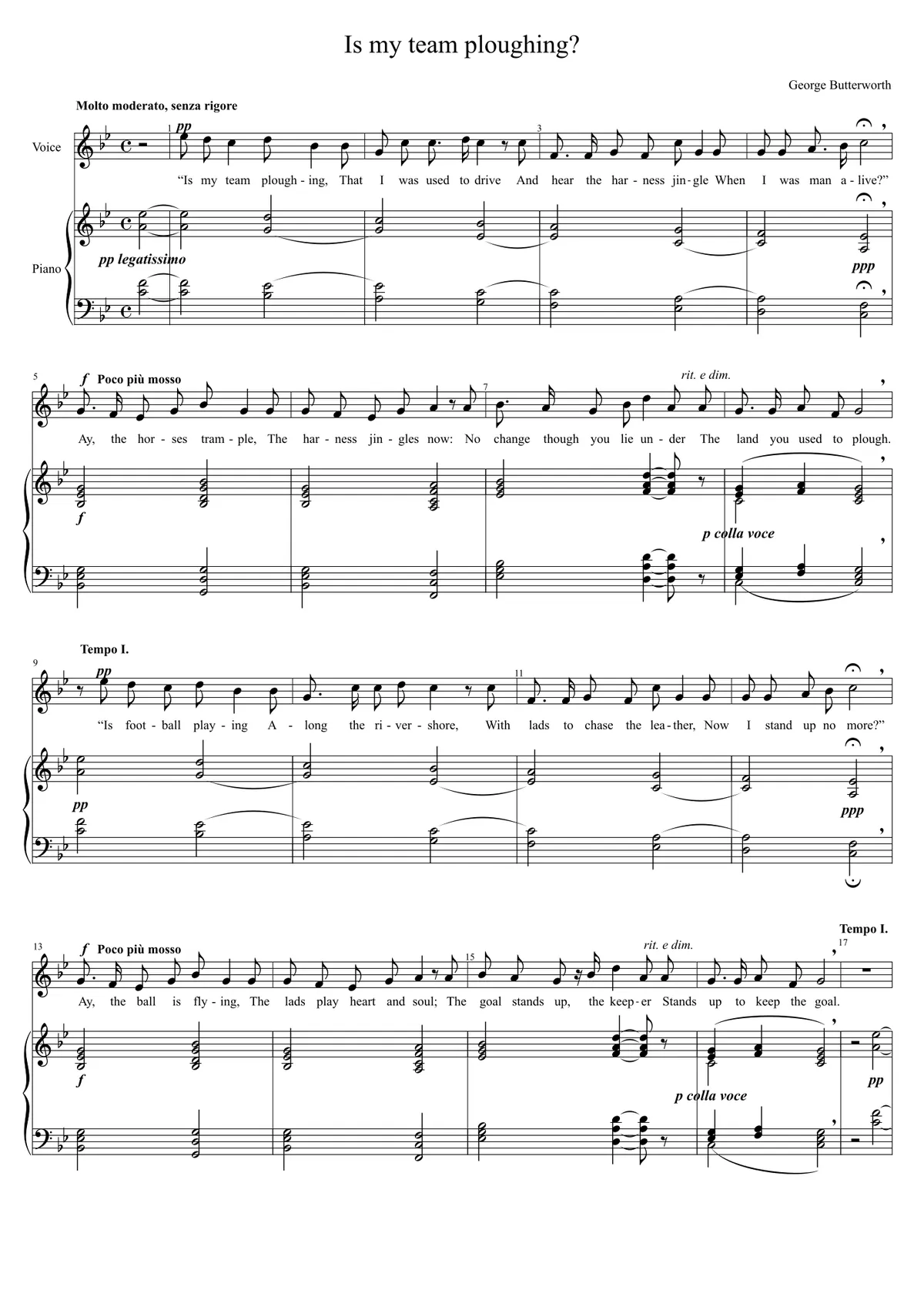
Is My Team Ploughing? closes George Butterworth’s Six Songs from A Shropshire Lad, published by Augener in 1911 on poems by A. E. Housman. It is a dialogue between a dead young man and the friend still living. The dead man asks, “Is my team ploughing, that I was used to drive?” and then whether football is still played by the river, whether his girl has stopped weeping, and whether his friend is well. The friend’s answers are reassuring until the last stanza, when he admits that he is sleeping easy because he now comforts the dead man’s sweetheart, and asks him not to ask whose.
Butterworth separates the voices sharply. The dead man’s questions are pianissimo, Molto moderato, senza rigore, over still, chorale-like half-note chords. The living friend answers Poco più mosso and forte. A slow, quiet Lento closes the song on “Never ask me whose.”
What to practice
The singer must play two people without becoming theatrical. For the questions, find a pale, almost suspended tone; each begins near the top of the range, E♭5, at pianissimo, so practice the onset softly and on breath before building the phrase. For the answers, warm and strengthen the voice and move forward with the tempo change.
Four question-and-answer pairs follow the same pattern, so vary them: the answers sound easy at first and grow more guarded until the last stanza drops into the Lento. Take time over the rit. e dim. before each new question. Housman’s plain English needs clear, natural diction; aim for a conversational quality without losing the legato.
Who it suits
With an octave range from E♭4 to E♭5 in this edition, it suits baritone or tenor, and mezzos sometimes sing it; it is an excellent study in characterization for undergraduate and graduate students.
Practicing it in Opusis
- Play the piano part on its own and sing over it: choose the voice part and switch to accompaniment practice, and the vocal line drops out.
- Move the song up or down by as much as an octave. The score is redrawn in the new key and the playback follows it.
- Set your own tempo and loop any passage until it sits.
Questions
- Who are the two speakers in Is My Team Ploughing?
- A dead young man asking about life back home and his still-living friend who answers. The final answer reveals that the friend is now with the dead man’s sweetheart.
- Which set is Butterworth’s Is My Team Ploughing from?
- It is No. 6, the last song of Six Songs from A Shropshire Lad. Vaughan Williams also set the same poem in On Wenlock Edge.
- What key is Is My Team Ploughing in?
- This edition is written with a key signature of two flats, with the voice moving between E♭4 and E♭5.